Search

Black Leadership Analysis

This is an unofficial Spiral Dynamics blog. It is not endorsed by D. Beck PhD.

Author

David Hartful Jr.

This site will use Ego Development Theory to analysis various leaders and problems in the black community. Ego Development Theory is a value meme classification first invented by Clare W. Graves and expanded by Natasha Todorovic, Christopher Cowan, and Don Edward Beck.

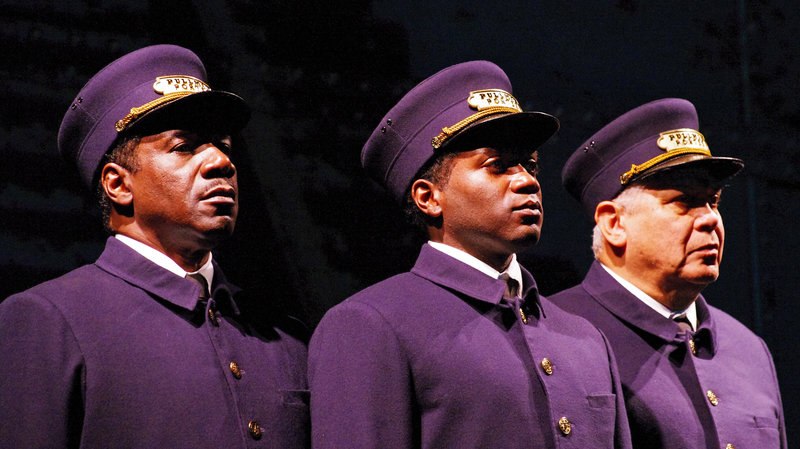
The Brotherhood of Sleeping Car Porters

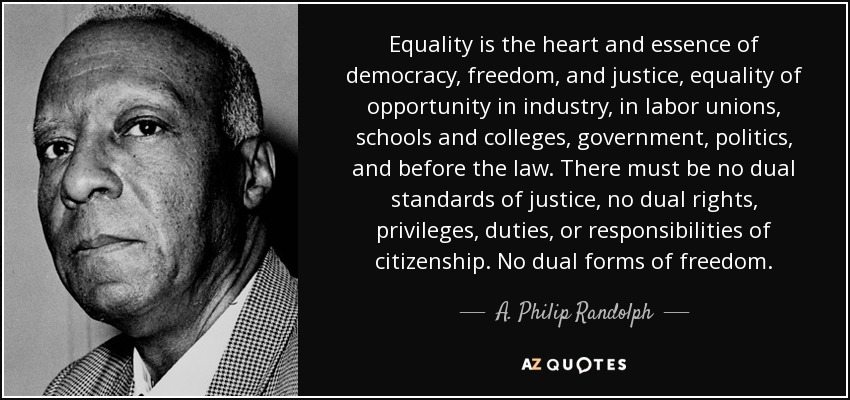
Asa Philip Randolph demonstrates to black leaders how to build coalitions. Randolph was also realistic about the limitations of his organization. The realization of his limitations led him to seek strategic alliances. While in these alliances he was able to keep control of his union and stay focused on his goal.

Randolph also understood that some organizations could derail his union. If he were to ally with a group that was too radical he would not only hinder the Brotherhood, he would also put many porters in danger. Randolph sought alliances with other mainstream organizations.

As most of the readers already know, Asa Philip Randolph organized The Brotherhood of Sleeping Car Porters and obtained a charter from the American Federation of Labor (AFL). He was successful in his efforts because he made strategic alliances to increase his power. An evaluation of the porter’s previous attempts to unionize will be used to demonstrate how “going it alone” is not realistic.

The first attempt to create a porter’s union was in 1890 with the Charles Sumner Association. Charles Sumner was a Senator that fought for Civil Rights. The Pullman Company threatened to fire all the porter’s and hire white replacements. The 1890 strike never happened. The second strike threat occurred in 1897, and again the company threatened to hire white replacements to stop the strike. The closest any porter got to making an appeal for higher wages was getting an editorial in a local newspaper in 1901.

The porter’s primary barrier to successful organizing was a lack of money. In the 1920’s a porter made $1,200 a year. The poverty line in the 1920’s was $1,500 a year. So most porters did not have money for savings or union dues. In addition to only making $1,200, tips composed twenty percent of the salary. As anyone that has worked for tips knows, tips fluctuate, leaving the porter in an even more precarious position.

Not having sufficient income made porter’s even more dependent on the Pullman Company. The company had a porter rule book with two hundred and seventeen rules. When that many rules are in place, every worker made numerous transgression every shift. Pullman had grounds to fire a porter at any time. In addition to not having income or job security, a porter would have a difficult time finding new employment. Pullman specifically recruited dark-skinned black people for the porter job. The job market discriminated against dark-skinned people. The loss of a porter job could be a setback that a black man would never recover.

In 1925, Randolph was selected to run the Brotherhood of Pullman Porters. His job is to finally give the porters a much-needed raise and change the rules to allow for porters to stand up to abuse. Randolph faces many of the same problems previous organizers will face. Membership fluctuates because people can not pay their dues. Instead of simply berating members, he went out to find allies with deep pockets.

Randolph sought out donations from liberal white churches. Donations from white churches keep the Brotherhood afloat for the tumultuous early years. Many of these churches were concerned with the welfare of black people. They have established wealthy membership that kept a steady stream of money flowing to the Brotherhood.

The American Federation of Labor (AFL) was another organization courted by Randolph. The AFL was the largest federation of unions at the time and had deep connections with the Democratic party. Both the AFL and the Democratic party had a long history of racism. In the North, blacks were not allowed in most unions. When unions went on strike, black workers would cross the picket line and fill the empty jobs. The AFL and Democratic party often conspired to create laws and reduce funding that would help black people as a way to retaliate.

Randolph knew that the AFL was the only union organization that could give the Brotherhood validity. Affiliation with the AFL would also give Randolph inside information on various initiatives in Congress. Most importantly the AFL could supply the Brotherhood with money in the event of a strike.

The Brotherhood received AFL affiliate status in 1929. The Brotherhood would pay the AFL $0.35 per member. A full AFL membership union only pays $0.01 per member. Many critics saw this not only as a “slap in the face,” but a poor use of scarce resources. Randolph understood that the AFL membership would be a long and arduous road. If the Brotherhood could survive this probationary period, they could obtain real government influence.

The Democratic party heavily pressured the AFL to begin to incorporate black members. The AFL had a long history of segregation in its affiliate unions. At one AFL conference, the group stated its official goal was to protect the livelihoods of native-born white men. The pressure came from the Democratic party’s need to keep control of the mayorship of many major cities, which had sharp increases in their black population. Also, the Democratic party wanted to pull membership away from third parties such as Democratic Socialists and Communists. The Democratic party could reduce the threat of a third party by being more inclusive.

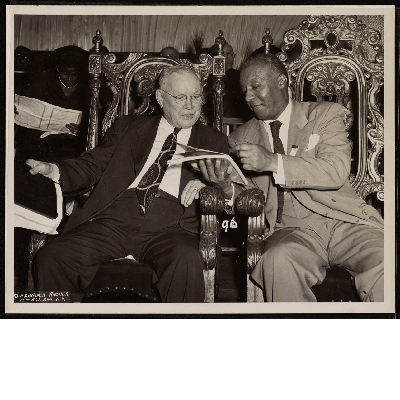
Randolph garnered the most criticism for his introduction of AFL president William Green in Harlem’s Abyssinian Baptist Church. He said Green was the second Abraham Lincoln coming to rescue the black worker from industrial bondage. Many critics used this overly enthusiastic introduction as proof Randolph was using the porters as inroads into the AFL. The AFL had a long history of excluding black people and had not allowed the porters to enter as full members.

The election of Franklin Delano Roosevelt 1932 was the jumpstart that both the Brotherhood and the AFL needed to merge. FDR instituted the National Labor Relations Act in 1935 and expanded the Railway Labor Act to include airlines. These laws set specific procedures to form a union, address grievances, and to go on strike. The introduction of a union-friendly administration increased membership in the Brotherhood of Pullman Porters. It is not a coincidence that the Brotherhood of Sleeping Car Porters got an official charter from the AFL in 1935. Having an administration that was friendly to the cause of black liberation had substantial effects. In 1937, the Brotherhood signed a contract with the Pullman company for higher wages and improved working conditions.

Many of today’s black leaders speak of black people becoming independent. Black organizations talk about divorcing themselves from white money and white members. Historically, completely isolated organizations do not work. It would be advantageous to look at what A. Philip Randolph’s alternatives were in the fight against the Pullman Corporation.

The obvious ally would be various black organizations around at the time most notably, the black church. If all these black organizations “pooled their pennies together” they could have serious money to fight injustices. The only problem with the strategy is that all the other black organizations had similar, if not worse money problems. In fact, Pullman gave generous donations to black churches to help in the fight against the Brotherhood. The Chicago branch of the National Urban League fought against the Brotherhood because of a large Pullman donation. The National Urban League funded most of the black politicians. Therefore, many of Chicago’s black politicians were against unionization. The lack of money in the black community hurts black organizations. Most black organizations are more concerned with getting donations to stay afloat and are willing to compromise ethics to get the donations.

The Brotherhood could have enlisted wealthier members of the black community. There were some prominent members of the black community that could have provided money. However, many felt threatened by the prominence of the porter’s in the black community. The few black professionals in major cities enjoyed being the wealthiest black people in town. If the porters obtained fair wages, they could challenge their status in the community. Most black professionals were deeply invested in Orange Meme striving. They were not interested in helping others.

One could say if you were going to ally with white people at least partner with white people that were integrationist from the beginning. The biggest rival to the AFL at the time was the Industrial Workers of the World (IWW). IWW was integrationist from inception in 1905. One of the founding members, Lucy Parsons, was born a slave in Texas. The IWW wanted to do away with the wage system and put workers in charge of the means of production. The IWW put itself in direct opposition to the AFL that wanted “A fair day’s wage for a fair day’s work.” If the Brotherhood joined IWW, they would have to challenge Pullmans validity in running the railroad.

The IWW radicalism also led to scrutiny by authorities. In 1906, the murder of an Idaho Governor implicated an IWW leader. Citizen accused IWW member of rioting in Butte, Montana in 1914. Migratory farmers were also a large part of the IWW membership. Unfortunately, migratory farmers were looked down upon and blamed for many unsolved crimes. Migratory farmers were called hobos in the 1920’s and viewed negatively by the general public. The activity that put the IWW the most at odds with the Federal government was its outspoken stance against World War I.

Many unionist believe the government systematically targeted the IWW to cause its downfall. Numerous high profile cases plagued the organization from the early 1910’s to 1920’s. By 1925, the organization was a shell of itself. The union will recover in 1960’s, but the 1920’s was a dark time for the IWW. Randolph understood what the IWW was going through and was smart to keep the Brotherhood away.

Eugene V. Debs, one of the founders of the IWW, was a hero of Randolph. Randolph wrote about Debs’ philosophy in college and his first years at “The Messenger.” Even though Randolph personally agreed with the philosophy of the IWW, including the IWW’s stance against war, he knew a partnership would not be practical. Randolph knew how to set his personal feelings aside for the good of the group.

Randolph’s life and work demonstrate effective leadership. It is a model that more black leaders should follow. He understood the limitations of his group and worked with organizations that would complement the Brotherhood. Once Randolph determined which organizations could be of service to him, he put aside his personal feelings a pursued the alliance. His efforts ultimately culminated in the first contract between a black union and a major corporation. Randolph’s pragmatism is something to admire.
Featured post

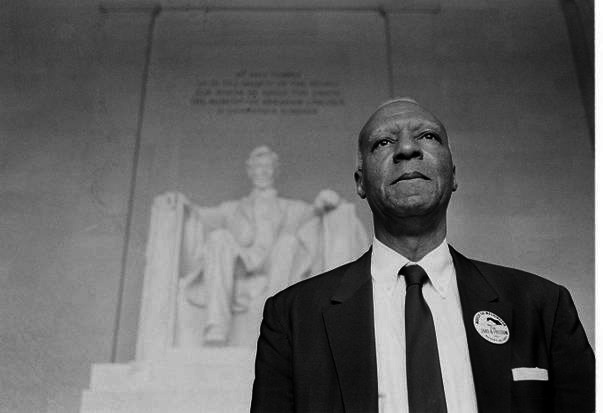
Asa Philip Randolph (1889 – 1979)

Accomplishments
 
+ Organized the Brotherhood of Sleeping Car Porters
+ Pressured POTUS Franklin Roosevelt into signing Executive Order to stop
segregation in Defense Contracting
+ Pressure POTUS H. Truman into signing Executive Order to end segregation in the
military
+ Directed March on Washington in 1963
+ First Vice President of the AFL-CIO in 1955 to 1968
+ Founder of Negro American Labor Council
+ Awarded Presidential Medal of Freedom by POTUS Johnson
+ The movie “10,000 Black Men Named George” was written about Randolph’s life
 
Short Biography
 
Asa Philip Randolph was born in Crescent City, Florida in 1889 to a working class African Methodist Episcopal preacher and his wife. Randolph’s father, James W. Randolph, was heavily influenced by Black Nationalism. In the early 1900’s Henry McNeal Turner, fellow AME preacher was first developing a philosophy that called for black people to leave America in mass and resettle in Africa.[D] Turner also believes G-d was black and it was important for blacks to see G-d in their image. Black nationalist thinking will have a profound effect on Randolph’s life.
 
Randolph’s parents were not only armchair philosophers; they lived what they preached. A black man was being held in a Florida county jail. A mob was preparing to lynch the detainee, and James Randolph organized a protection force to surround the jail. His mother sat at home and protected the family with a loaded shotgun.[C] Philip Randolph vividly recounts the story in many sources.
 
In Randolph’s early years he excelled in school. Randolph graduated valedictorian of his high school class in 1907. He left Florida to pursue an acting career and went to New York City in 1911.[A] While in the acting community he was first introduced to Socialism. He began to devour all the information he could on the new philosophy. While at one of these Socialist meetings he met Chandler Owen, a Columbia law student. The two began a partnership that synthesized various elements of Socialism and black liberation. The pair was colloquially known in Harlem as “Lenin” (Owen) and “Trotsky” (Randolph).
 
The partnership of Randolph and Owen culminated in the periodical they published called the “Messenger” in 1917. “Messenger” campaigned against lynchings, American participation in World War 1, and segregation. The publication was endorsed by the Socialist Party of America and deemed by the Department of Justice as “the most dangerous of all Negro publications.” [A]Various ideological differences caused the publication to disband in 1919. [A]
 
Randolph initial forays as a union organizer were troublesome. He first attempted to organize New York City Elevator Operators. He then became president of the National Brotherhood of Workers of America, a shipyard worker union. The National Brotherhood dissolved due to pressure from the American Federation of Labor (AFL).
 
His greatest success as a union leader came with the Brotherhood of Sleeping Car Porters (BSCP). The largest group of Sleeping Car Porters worked for the Pullman Company. The Pullman Company was one of the biggest railroad companies in the early 1900’s. The Sleeping Car, as the name entails, had sleeping berths to allow a person to sleep on long train rides. The Pullman Company had a reputation for the best and most luxurious sleeping cars. A trip on a Pullman Car would be a huge status symbol.
 
A Sleeping Car Porter would be equivalent to a modern day airline stewardess, hotel concierge, and luggage handler all in one. The Sleeping Car Porter would greet the traveler on entry, carry their bags, inform them of train rules, show them around the train. Before the porters unionized, they would commonly work one hundred hours a week. The pay was $1,230 a year in 1927, when the poverty line was $1,500.
 
Randolph was elected president of the BSCP in 1925. It was the first time a black union took on a large corporation. As with many other labor movements, Pullman Company used violence and intimidation to subvert unionizing efforts. Despite adversity, the BSCP was able to sign 51% of porters into their union in the first year.[A] In 1935, Randolph was able to begin negotiations with the Pullman Company. In 1937, the Pullman Company entered the contract with the BSCP.
 
Randolph’s success in the BSCP made him a prominent figure in Civil Rights. He decided to turn his attention to racial segregation in the war industry. He partnered with Bayard Rustin to organize the March on Washington for Jobs and Freedom in 1941. Randolph threatened to have 50,000 people protesting in the city. POTUS F. Roosevelt felt the pressure and signed Executive Order 8802 also known as the Fair Employment Act. The Fair Employment Act ended racial segregation in war industry. The 1941 March was called off due to the signage of the executive order.
 
Randolph understood his work was incomplete. He now focused on ending segregation in the armed forces. Randolph formed the Committee Against Jim Crow in Military Service to pressure the government into abolishing segregation in military service. He went as far as telling black people not to register for the draft.[A] POTUS H. Truman felt this pressure and signed Executive Order 9981 to abolish military segregation in 1948.[A]
 
By the 1950’s, a new group of Civil Rights leaders was coming to the forefront. The most promising of the bunch was a young Georgia preacher named Martin Luther King Jr. Randolph arranged for Bayard Rustin to teach King how to organize and build coalitions. Rustin and Randolph’s tutelage culminated in King being the keynote speaker at the 1963 March on Washington for Jobs and Freedom.
 
While advocating for Civil Rights on the whole Randolph continued to fight for labor rights within the American Federation of Labor (AFL). America has a long history of racism and segregation in labor unions. Randolph also decided to fight this corruption inside the unions. The AFL chartered the BSCP in 1935. Randolph’s involvement continued through the merger with the Congress of Industrial Organizations (CIO). Randolph served as vice president of the newly formed AFL-CIO from 1955 until 1968.
 
Randolph also got Civil Rights leaders involved in the labor movement. The only time Malcolm X participated in a labor strike was 1962’s fifty-six-day strike for the benefit of hospital workers at the Brookdale Medical Center. Malcolm X spoke at their rally and publicly supported the black and brown workers. It is important to note he shared the platform with Dr. Martin Luther King. [B]
 
A. Philip Randolph died in 1979 of a heart condition


Sources:
Books
Banks, W. M. 1996, Black Intellectuals: Race and Responsibility in American Life, New York: W. W. Norton & Company.
Randolph, A.P 1917 and Owen, Chandler, Terms of Peace and the Darker Race, Poole Press Association (E-book version on Google Play)
Internet
A. Pfeffer, Paula F. (2000). “Randolph; Asa Philip”. American National Biography Online.
B. “A look at Malcolm X as a mirror for America” New York Times 12-16-1992
C. Asa Philip Randolph biography on http://www.aflcio.org
D. Scott, Daryl (1999) “ Immigrant Indigestion” Center for Immigration Studies

What Is a Pullman Porter?

The Pullman Porter had a pivotal role in the Civil Rights Movement. His official job description was to assist the passengers on the luxurious Pullman Sleeping Car. His real job was to create the black middle class and forge countless organizations. The porter is known primarily for the Brotherhood of Sleeping Car Porters, which marked the first black labor union to sign a contract with a large company. In addition to all the historical accomplishments of the union, the porter provides vital insight into the black experience.

The first point of business is explaining the Pullman Company. The Pullman Company manufactured luxury train cars for overnight travel. The Pullman Company also contracted out the crew to run the car. The crew members were called Sleeping Car Porters. The founder George Pullman began the company after having to sleep in the train chair on an overnight trip to visit relatives. He started to design a car with rooms with full-size beds called berths. Pullman also elicited help from the government to create favorable laws and obtain funding. Pullman befriended the son of Abraham Lincoln, Robert Todd Lincoln while petitioning the government. Lincoln took over the company after the death of George Pullman. Both men were fiercely anti-union regardless of the race of the members.

In the simplest terms, a Pullman Porter is equivalent to airline stewardess with far more responsibilities. A porter would greet the passenger upon entrance to the train, carry the bags, show the passengers around the car, and cater to the various needs of the passenger. Porters acted as babysitters while parents drank, nurses when the elderly passengers were sick, and safety advisors when the tracks got rocky. The porter was always available with a smile to make sure his passenger’s trip was remarkable.

Pullman preferred to hire dark-skinned, tall, thin porter’s from the American South. They needed to be tall to reach the shelves above the berths. He needed to be thin to walk by passengers in the narrow hallway without touching. Southern to be sufficiently submissive, Northern blacks were often too rowdy. The dark-skin was especially important. Dark-skin marked the division between passenger and porter. The passenger needed to see the porter, but the passenger should never be obliged to consider the porter fully human. The porter was “other,” a servant, and he wanted the passenger to see him as such.

The passengers on Sleeping Cars were known for their rambunctiousness. The Pullman Car was one of the most expensive ways to travel at the time. The liquor flowed freely on the train, so much so, that passengers often “found themselves in strangers beds.” A Pullman trip would be equivalent to a modern day cruise.

In addition to most passengers spending a significant amount of time on the journey drunk, the white passenger treated the porter with very little respect. The most notable feature of the disrespect was referring to all porters as “George.” The name harkens back to slavery when slaves received their master’s last name. Since the owner of the company was named George, all his black workers were George by default. Termination was the penalty for not answering to George. The Pullman Manual had two hundred and seventy rules. A porter could never show and any indication that he was angry or hurt by a passenger’s comment.

Even though porters were not allowed to fraternize with the passengers, many passengers made advances on the porters. Sumner Welles was Undersecretary of State in 1940. Welles was exemplary as a diplomat and was picked to succeed the current Secretary of State Cordell Hull. Welles derailed his career by getting drunk and offering a porter money for sex. The porter told superiors, and other porters said Welles made the same advances on them. Various government officials confirmed the story and Welles was not picked to be Secretary of State. A 1977 tell-all memoir was the first utterance of this story.

Not all advances were turned down. Here is a story of a young porter and a bride whose husband had to disembark early from the train. The account comes from Larry Tye’s book Rising from the Rails.

Watching her husband ride off in a covered wagon, she struck up a conversation with [A porter] “You -you know you’re the first Nig-nigger I have ever talked to. Can I? I? – believe all- believe all my mother and father have told me about you people?” she inquired hesitatingly, with a peculiar smile. Her remarks flashed through my mind, bringing with them thing the boys had told me that white people say about niggahs, and I realized what she was suggesting. It’s sure hard to make white people believe that what they say might be true about some of us, but not about the whole race. Still, as the legend is to our advantage, I left my work for an hour, so that it shouldn’t die with me.

Not all white and black interchanges were agreeable. The porter had to find ways to protect himself that did violate company rules. Larry Tye recounts a story from The Autobiography of Malcolm X. Malcolm X worked for a few years as a Pullman Porter before turning to a life of crime and later conversion to Islam.

I remember that once, when some passengers complaints had gotten me a warning, and I wanted to be careful, I was working down the aisle and a big, beefy, red-faced cracker soldier got up in front of me, so drunk he was weaving and announced loud enough that everybody in the car heard him, “I’m going to fight you nigger.” I remember the tension, I laughed and told him, “Sure, I’ll fight, but you’ve got too many clothes on.” He had on a big Army overcoat. He took that off, and I kept laughing and said he still had on too many. I was able to keep that cracker stripping off clothes until he stood there drunk with nothing on from his pants up, and the whole car was laughing at him, and some other soldiers got him out of the way. I went on. I never would forget that – that I couldn’t have whipped that white man as badly with a club as I had with my mind.”

Relations between blacks on the train was also interesting. Because porters had to suppress their anger toward passengers they often lashed out against each other. Often porters would accuse other porters of “cooning.” Cooning is acting overly obliging to get bigger tips. A charge of cooning could come from having too big a smile for too long or the egregious dancing for customer’s amusement. Ultimately, all the porters had to compromise their pride to work for the Pullman company. An arbitrary line separates following orders and cooning. Cooning was always something the other guy did.

The other large part of the Pullman crew was the kitchen staff. To keep with plantation tradition, the kitchen workers were normally light skinned. Often porters would say waiters were soft and did not work hard. Many people will say that this is a remnant of anger from the plantation hierarchy. Light-skinned slaves, commonly descendant of the master, got “easier” jobs in the house. I think that the animosity between porters and kitchen staff was just another way to expel suppressed anger from passenger’s behavior.

Ultimately, kitchen staff and porters worked together. Kitchen staff would save scraps to make stew. Porters would keep an eye out for empty berths to allow the cooks and waiters to get a good night’s sleep. The kitchen staff could easily sneak out before the passengers awakened. In the end, both kitchen staff and porter were on the same team. If they did not work together, they would sink together.

I will detail the formation of The Brotherhood of Sleeping Car Porters in later blog posts. As of now, I will say the contract between Pullman Company and The Brotherhood will be the first time and all black union will force a major company to sign a contract. The victory catapults Brotherhood President A. Philip Randolph to national acclaim. He uses his fame to make the National Negro Congress, which is a militant alternative to the NAACP. The National Negro Congress folds due to internal conflict. He learns many leadership lessons from the organization and begins a campaign to desegregate the government and military.

To rally support, Randolph rallies crowds around the idea of a March on Washington. Originally, Randolph was going to get 10,000 people to demonstrate in Washington, DC. Once he started relaying the idea to crowds across the country people from all over the nation and of all political persuasions. Randolph officially set the date of the march on June 27, 1941.

Franklin D. Roosevelt did not want a public demonstration at this time. FDR was attempting to gain support for joining in the fight in World War II. He was also afraid that communist would cause a disturbance in the rally and put American race relations on a world stage. FDR met with Randolph to come to a compromise that would allow for Randolph to call off the march. The result was Executive Order 8802 which desegregated the defense industry government and contractor. Two days before the March on Washington 1941 was to happen it was called off.

Randolph does not just fold up shop and go home. He expands the March on Washington Movement. He builds a March on Washington headquarters in all major American cities. The March on Washington protest take place all over the country for twenty years, and it causes change at the local level. On the national level, the March on Washington Movement forced Truman to sign Executive Order 9981, finally desegregating the military. The last March on Washington was in 1963. Dr. King’s gives his “I Have A Dream” speech at this rally.

Dr. King owes much of his career to Randolph and Ed Nixon. Ed Nixon was President of the Montgomery Branch of the Brotherhood of Sleeping Car Porters. Because Nixon was running the Brotherhood and various Montgomery political organization, Ed Nixon recommends Dr. King to run the Montgomery Bus Boycott. The boycott lasts for over a year. Dr. King proves to Nixon he has potential and Nixon introduces him to Randolph. Randolph and his team gave Dr. King the tutelage he needed to lead the movement.

In addition to providing an organizational template and leaders, the Brotherhood provided funding for various organizations in the Civil Rights Movement. Randolph’s motto was, “ Whoever pays the piper calls the tune.” For a black organization to be truly independent, it had to be funded by black people. Malcolm X echoes the same sentiment in later years. Randolph would often invite Malcolm to his personal residence to tell him stories of the Harlem’s socialist movement and talk about politics. A. Philip Randolph and other black leaders including Elijah Muhammad started blacks down the road to self-determination.

The Pullman Porter has a dubious legacy in the minds of Black America. On the one hand, they had a servile role and had to take abuse without fighting back directly. On the other hand, they laid the foundation for the Civil Rights Movement of the 1960’s. I feel the Pullman Porter is the ultimate symbol of the black middle class. Often we work in jobs in which we are under-utilized and treated with disrespect. Not to the same extent as the porter, but disrespect nonetheless. We do that to support the aspirations of our family and those that want to fight white supremacy directly. The fight against white supremacy takes many forms. Blacks have to utilize many methods to fight it. The porter was one of the most cunning soldiers in this battle.

The information for this blog post comes from Larry Tye’s book Rising From The Rails

For more information on the Pullman Porters please vist the official museum. HERE

Featured post

Asa Philip Randolph

The Leader Analysis for Asa Philip Randolph will be done in a series. Randolph was one of the most successful leaders and his career spanned sixty years. These sixty years 1910’s to 1970’s were some of the most pivital for black thought on politics, philosophy, and economics. Randolph moved from a radical socialist to a leftist Democrat in his career. The following series is only a glimpse of his life.

What Is A Pullman Porter
APR Biography
The Brotherhood Of Sleeping Car Porters
Randolph & The National Negro Congress
March On Washington Movement
APR Basic Philosophy
APR Analysis

Read This If You Talk “WHITE”

This post will use the work and philosophy of Susan Cook-Greuter to analyze a common dynamic in the black community. The dynamic is on a personal level, and it happens when a person is accused of not wanting to identify with the black community when they display a personality trait not usually seen in the black community. Often people are charged with “Talking White” by speaking correctly. However, there are many other common triggers for this dynamic a few include:
 
+ Having dress inspired by a culture other than Hip-Hop
+ Striving to leave an economically depressed area
+ Having a culturally diverse group of friends
 
Typically the dynamic plays out with a black person that is focused more on goals, to ease communication I will call this person by the Cook-Greuter stage Conventional, and a black person more focused on relationships at the Cook-Greuter level Pre-Conventional. The Conventional person displays a personality trait seen as not prevalent in the black community. The Pre-Conventional person feels the relationship being threatened and attempts to reign the Conventional person back into the fold. The Pre-Conventional person’s need to restrain leads to a verbal or sometimes physical conflict. Frequently, the Conventional person is labeled a “sell-out, ” and the Pre-Conventional person is labeled “ghetto.” These labels are internalized and create conflict and suffering throughout the life of both individuals. Reframing the issue will allow for both parties to move forward in a healthy manner.
 
Many people will say the Pre-Conventional vs. Conventional dynamic is nothing more than simple bullying or conflict experienced by all kids of all races. The difference between an intelligent black child being called “white” and an intelligent white child being called a “nerd” is the attack on identity. If a white child is referred to as a nerd, he is given an identity. If a black child is called white, he has his identity taken away. In the early stages of ego development identity is a chief concern. Therefore, the Pre-Conventional vs. Conventional dynamic can be severely damaging to youth. The damage continues into adulthood and becomes an emotional shadow. Also, the Pre-Conventional vs. Conventional dynamic is played out in adults in more subtle ways. However, a brief summary of Susan Cook-Greuter’s methodology and philosophy is needed before further discussion.
 
Summary of the work of Susan Cook-Greuter
 
Susan Cook-Greuter is a Harvard psychologist who studied Ego Development, the concept that there is a set progression of a person’s view of himself. The progression of self-concept or ego can be identified, and there are common themes and personality traits in each stage. A person cannot skip a step, and everyone goes through each stage in the same order. People can stay in one stage all their life. However, there will be a few individuals that move up the entire hierarchy.
 
Comprehensive Language Awareness (CLA) is the basis for Cook-Greuter’s philosophy. In CLA, reality is seen as a continuum of interdependent sensations. Language is a concept that is used to differentiate the sensations to allow for further understanding and expanding our experience to other people using communication. As we age, we perceive the various concepts created in language as reality. The confusion between the concepts and reality cause suffering.
 
Because language is the external expression of internal reality, the complexity of one’s language is measured. The individual’s language complexity can be used to determine the individual’s view of reality. Susan Cook-Greuter devised a language test administered over ten thousand times. She saw nine distinct stages after analyzing all the data. Other psychologists independently confirmed the stages.
 
There are nine (9) stages in Susan Cook-Greuter’s philosophy. A very brief description of each stage can be found below with the main fear. Fear is one of many attributes that define each stage.
 
0. Symbiotic Stage: The stage of all infants there is no differentiation of the self and other. The concept of fear has not developed.
 
Pre-conventional Stage
Impulsive: This level lasts from toddler to twelve years old, and self is seen as “in need, ” and other is seen as “provider.” The main fear is abandonment.
Self-protective: This level is common in the teenagers. The self is seen as stronger or weaker than other. The power dynamic is used to meet needs. The main fear is domination by others.
Conformist: This level focuses on being seen by others or “respected.” Fitting into external standards to be seen as acceptable to others is the chief strategy for getting needs met. The main fear is dissolution or change in the peer group.

Conventional Stage
4. Expert: This level focuses on a person discovering their unique talent and differentiating themselves. Self is different and superior to others, at least superior in some ways. Chief fear is loss of status
5. Achiever: This level has honed the talent and has begun to reap tangible results. Self is different and capable of understanding others. Chief fear is the loss of autonomy.

Post-Conventional
6. Pluralist: This level understands self is using an arbitrary framework to understand the world. Self understands frameworks of others; all frameworks are equally valid. Chief fear is not finding one’s true self
7. Autonomous: This level understands that frameworks are ultimately fallible and make meaning without frameworks. Self in as part of a historical continuum filled with others. Main fear is not living up to a person’s full potential.
8. Postautonomous stage: This level understands the self is just a framework, and a self-imposed life story is the cause of suffering. Main fear is no one will be able to understand them at this advanced stage.
9. Unitive: This level has let go of the concept of ego completely. No chief fear because there is no “self” to threaten. However, the idea of self is available if needed.
 
To bring the conversation back to the Pre-Conventional vs. Conventional dynamic, the basis of the conflict is the incompatibility in fears. A Pre-Conventional paradigm is chiefly in fear of abandonment in one form or another. A Conventional paradigm is primarily fears loss of individualism. If the Conventional person does something to make the Pre-Conventional question the group identity, then the Pre-Conventional has to stop the Conventional person. If pressure is placed on the Conventional person, they will always defend their individuality. The two paradigms are horribly incompatible.
 
The conflict can be especially damaging for black people on both sides. In today’s more integrated world black people are often in a situation with few other black people. If being around the few other black people near him is taxing, he will often write-off black people. Many blacks don’t associate with other black people due to emotional shadows from the Pre-Conventional vs. Conventional conflict. Sometimes the disdain is explicitly stated, and sometimes the disdain is not explicitly stated.
 
I will use an example from my life to illustrate how this conflict plays out.
 
In college, I worked in a laboratory doing research on artificial joints. Many of the other students in the program were graduate students, and after work, we would go to a local brewery. The brewery was a predominately white establishment, but I did not feel uncomfortable. I felt I was with my peers and co-workers. I liked the place, and I decided to take one of my black friends, Eddie, there on the weekend.
 
When we got there I got a beer, and he got wine. Most people at a brewery drink beer. He went back for a second wine, and he felt he had to wait a long time. He assumed that the bartender did not want to serve him because he was black. Many people believe black people do not tip. I countered by saying it is a busy night and this is your first time here. He should come more, so people get to know him. My rebuttal to Eddie’s conclusion that the incident was racially motivated sent Eddie through the roof and demanded we leave. He felt I was defending white people and I was blind to racism right in front of me.
 
He went on to say how he felt he could not relate to me. In his opinion, I did not identify with black culture enough. I will admit I did worry about racism less in college. My focus was on achieving, making good grades, and getting a good job. At the time I felt that racism was a distraction. Only concentrate on the things you can control. If Eddie or any of my other friends brought up racism, I would change the subject. I justified it by saying that I only want positivity in my life.
 
One of the many drawbacks of the Conventional stage is hyper-rationality. Hyper-rationality is when a person sees only the material side of an issue. When Eddie said he had to wait a long time for a drink and he felt that it was due to racism, I thought well he has a drink now, and he can’t prove that the wait was due to racism. I could only see the material aspect of the issue.
 
In addition to not seeing the emotional side of the issue, I was also heavily invested in feeling that individual striving could overcome racism. I wanted to be an engineer and have financial stability. If racism could derail me, then I will not be successful, and I will no longer have status. Also, if racism is prevalent, it is selfish for me to concentrate on my success. The bigger problem is racism, and I should be fighting racism. The extreme focus on my striving led to creating a shadow. The shadow is something that people of all races create to justify having a focus on self. A shadow I only recently gained the tools to dissect properly.
 
People in the Conventional stage have a hard time relating to the emotional side of the situation. My friend was hurting, and I should have been there for him. If he wanted to leave, I should have just left. My need for good beer was not that significant. The friendship was more important, and in hindsight, I did not have the capability to preserve the relationship.
 
Over the years we had about a million arguments around the same theme. I moved to South Carolina, and we lost contact. I often think about various arguments we had and replay them in my head. I want to know if I was justified in my rebuttals to the arguments. I wonder if his criticisms of me were valid. In retrospect none of that matters, it is all about the relationship.
 
I believe understanding the Pre-Conventional vs. Conventional conflict in all its forms superimposed on race is a crucial step in healing the divide between black people. We have to get past all the labels we put on each other and ourselves. If not we will sabotage each other at every turn.
 
The Pre-Conventional vs. Conventional emotional shadow can start to be resolved in the Post-Conventional stage. In the Post-Conventional stage, people begin to let go of the idea of ego. They can also begin to accept and understand their shadow. In most of the Conventional stage, any criticism is an attack on the self. Post-Conventional people can take criticism and self-critique if necessary. If you find yourself or know someone wanting to tackle this issue here are some steps you can take to dissolve the shadow.
 
Steps to take to resolve this issue
 
First thing is a person needs to own that they have an emotional shadow around this issue. Evaluate how this particular issue plays out through journaling. Do not concentrate on what the other person did to you. Focus on the areas you could have changed and possible blind spots you have due to a hyper-focus on personal success. You can only control yourself, so become the best person you can be. Also, have defenses ready when you encounter the Pre-Conventional vs. Conventional dynamic.
 
It would also be a good exercise to go through all the labels you have put on yourself and others when going through this dynamic. Often you may call someone “Ghetto” in a Pre-Conventional stage or if they are in a Conventional stage, “Boujee.” These labels cut both ways. By labeling someone “Ghetto,” you label yourself as “not Ghetto.” Then a subset of self – identity forms in which you can not do or like things that are “Ghetto.” The need to hold on to a “not Ghetto” identity can cause various pathologies including, overspending, isolating yourself, or disparaging other blacks. Much of the inter-class conflict in the black community comes from dealing with this dynamic.
 
Remember dealing with emotional shadows is a serious issue. There is a good chance you may never fully recover from the damage. Do not listen to people telling you this is a trivial concern. The effects of the Pre-Conventional vs. Conventional dynamic are your experience and only you know the amount of damaged caused by the experience.
 
What to do if your child goes through this?
 
Now that we live in a more integrated society the experience of black people is more stratified. In addition to a wider variety of experiences, we have more exposure to whites and white culture. So the Pre-Conventional vs. Conventional dynamic will become more and more prevalent. If you child comes home complaining about the way other black kids treat him, don’t shame the child for his or her feelings. If you do shame your child, they will hide the feelings from you and later their friends. The worst case will be the child develops an emotional shadow around the feelings at a young age that they never overcome.
 
The first thing you should do is realize that the child’s conflict with other black kids is due to advanced ego development. It is not the result of shame in being black or arrogance. Once you realize that your child experiencing this conflict is not a bad thing, help the child to reframe the issue around differing values in each person. Pre-Conventional stage people are focused on relationships. Conventional level people are focused on goals. Once the child realizes that the issue is not about whether they are “black enough” they can approach the situation at a more logical level. It could be true that the best short-term strategy is to avoid the other children, but when a new group of people comes around the child will be able to look at those people with a fresh face. A new relationship will not be affected by old baggage.
 
Conclusion
 
Emotional shadows caused by the Pre-Conventional vs. Conventional dynamic cause serious trouble in the black community. There needs to be a serious effort to reframe the dynamic that allows us to reflect on the situation in a more logical manner.
 
Most of the information for this blog post came from “Nine Levels of Increasing Embrace” by Susan Cook-Greuter. For more on Susan Cook-Greuter check out her website http://www.cook-greuter.com.

Moral Development : Kohlberg and Gilligan

David Hartful Jr.'s avatarBlack Leadership Analysis

This article is about two theories of moral development outside of Spiral Dynamics. These two researchers were influential in the study of human development. Kohlberg’s work focused on person’s ability to internalize fundamental moral principles. Gilligan work concentrated on a person’s ability to create and sustain healthy relationships. Both of these researchers were influential to Integral Theory and the work of Ken Wilber.
 
Kohlberg
 
Kohlberg’s background
 
Lawrence Kohlberg was born in 1927 in New York. His parents separated when he was four and had split custody in his youth. As a young adult, he smuggled Jewish refugees from Romania to Israel. He lived in Israel during the revolution but concentrated on non-violent forms of protest. After the revolution, he lived in a Kibbutz for a short time before studying at the University of Chicago.
 
After graduating with a Ph.D. in psychology, he developed his theory of…

View original post 1,621 more words

Moral Development : Kohlberg and Gilligan

This article is about two theories of moral development outside of Spiral Dynamics. These two researchers were influential in the study of human development. Kohlberg’s work focused on person’s ability to internalize fundamental moral principles. Gilligan work concentrated on a person’s ability to create and sustain healthy relationships. Both of these researchers were influential to Integral Theory and the work of Ken Wilber.
 
Kohlberg
 
Kohlberg’s background
 
Lawrence Kohlberg was born in 1927 in New York. His parents separated when he was four and had split custody in his youth. As a young adult, he smuggled Jewish refugees from Romania to Israel. He lived in Israel during the revolution but concentrated on non-violent forms of protest. After the revolution, he lived in a Kibbutz for a short time before studying at the University of Chicago.
 
After graduating with a Ph.D. in psychology, he developed his theory of moral development. The paper published in 1958, the original study focused on influential and wealthy white males. His initial conclusion was women can not move past stage three of his six stages. Studying later in his career found similar results when adding women and other cultures to the study. At the end of his work, he did conclude women can evolve through all three levels and all six stages. Below is a brief description of the three levels.
 
Preconventional Behavior
 
Preconventional Behavior is the first level of moral behavior. The first stage focuses on selfish benefit. In Spiral Dynamics this behavior is classified in the Red Meme. In Kohlberg’s work, punishment avoidance is the first stage, and reward-seeking is the second stage. A person at the conventional level judges the level of moral corruption in an action by the amount of punishment it induces. Likewise in stage two, a person will judge the virtue of an action by the size of the reward. It is tough to control people at this level due to the fact they are at the whim of their emotionality.
 
Conventional Behavior
 
The Conventional level of moral behavior has begun to internalize society’s moral codes, but still ultimately does this for personal stability. Stage three moral behavior conforms to the standards of society to ensure one’s status in his social group remains high. At stage three, people realize that being well received by others can lead to immediate rewards and rewards in the future. A person no longer needs an immediate reward or punishment. Roughly, this is analogous to the Orange Meme.
 
In stage four, a person concentrates on law and order. In this stage, a person has moved past his social standing and is worried about the society as a whole. A person at this stage would say “ What if everyone parks in a handicapped spot?” Or “What happens when everyone downloads music? The entire industry could be crushed.” At this stage, a person will have consistent behavior even if no one is looking or will find out. However, the ultimate motivation is for a person to live in a stable society. Therefore, it is ultimately self-centered. Roughly this is analogous to the Blue Meme.
 
Postconventional Behavior
 
In the post-conventional level, people move beyond their personal comfort and start to build a more just society. At this level, the rules and laws of society are followed only if they meet the moral judgment of the subject. In this level, a person will find people that help slaves on the underground railroad or conscientious objectors to war.
 
The motivation for Stage Five is the social contract. A person’s morals are influenced by other people’s perspectives, and final judgments are made involving the well-being of the group. The ultimate goal is to create the greatest good for the greatest number of people. Kohlberg concluded that democracy operates at this stage of development. Stage Five is roughly Orange / Green Meme.
 
Universal ethical principles motivate Stage Six. Immanuel Kant best personifies this stage. In this stage, a person acts solely from their moral reasoning due to their evolution. Kohlberg found very few people at this stage of development. Stage Six is roughly analogous to Yellow.
 
Conclusion on why women cannot move past stage three.
 
In Kohlberg’s work in 1958, he concluded that women could not move past stage three. In his analysis, a woman will always be chiefly concerned with how her family viewed her. He does not take into account it is difficult in the 1950’s for a woman to get a position of influence outside of her family. Therefore, she does not have the opportunity to develop moral ideas that include people outside the family. Kohlberg chose influential and wealthy white males for his study because they have the most opportunities to expand their viewpoints. His later studies included women and minorities. In his later studies, he concluded moral development is not contingent of gender or race. The change in his thinking would also coincide with more women and minorities having positions of power.


Gilligan
 
Gilligan’s background
 
Carol Gilligan was born in New York in 1936. She married a fellow graduate student at Harvard. She got the opportunity to teach with Erik Erikson whom she says is very influential in her work. She studied under Kohlberg learned his methods and later became his best critic.
 
It is important to note that the people around heavily influenced Gilligan. She lived in married people’s housing at the University of Chicago. Gilligan lived and interacted with minority women all day long. She was also part of an interracial dance company in Chicago. Voter registration and protesting the Vietnam War were issues she that she had substantial involvement. She said that psychology is portraying the world of white men.
 
Ultimately, Gilligan agrees with Kohlberg’s overall levels, the subject’s relation to those around her is the basis of her work. Her most famous work “In a different voice.” She chose to study women contemplating abortion due to the recent judgment in Roe v. Wade. In Gilligan’s opinion, this is the one decision a woman can make independently. I will summarize her stages below.
 
I love me
 
“I love me” is from the Preconventional level. The primary goal is to have the easiest life possible. A woman at this level is chiefly concerned with how her decisions will affect her. The effect of their action on those around them is not a concern.
 
In regards to the abortion question, a woman will evaluate how having a baby will affect her plans in the future. If she believes having a baby will not keep her from friends or going to school, she will have the baby. If she believes having a baby will be the end of her goals, then she will have the abortion.
 
I love you
 
“I love you” is from the Conventional level. The primary goal is to please the person you are with or your family. In this stage, women will only evaluate how her decision will affect her family. This viewpoint can result in putting your needs so far in the background the woman can inflict harm on yourself. Some have expressed this view as “I love you more than me.”
 
In regards to the abortion question, a woman will evaluate how having a baby will affect her family and how it hits in with her religious value system. How the pregnancy will affect her is almost irrelevant. In this stage, a woman should be careful that she is not doing real harm to herself with whatever her decision on her pregnancy.
 
I love us
 
“I love us” is the Postconventional level. The primary goal is to come to the best decision for herself and her family. “I love us” is the highest level and very similar to Yellow meme in Spiral Dynamics. In this stage, a woman logically evaluates her options and chooses the best thing for everyone involved.
 
In regards to the abortion question, a woman will fully assess how terminating the pregnancy or keeping the pregnancy will affect all those in her sphere of influence. She understands how both options will impact her mental state. There is also a plan for comforting her family and repairing relationships.
 
Conclusions on differences between Kohlberg and Gilligan
 
I think it is important to note that both Gilligan and Kohlberg include both genders in their highest levels of moral development in their later work. Gilligan attributed the difference to gender. In Gilligan’s work, most women develop relational morals, and most men develop absolutist morals. I will say that there are differences due to gender, but I think there some much bigger factors here.
 
The most significant factors here are the breadth of views and range of influence. Going back to the spiral dynamics framework, each value meme represents the ability to take on one more view. Red is egocentric), Blue is second ethnocentric, Orange is nation-centric, and Green is world centric. These memes play out differently due to your sphere of influence. If you are wealthy and can insulate yourself from the repercussions of your actions you can have a more absolutist moral view. If a poor person sues a company for the discrimination, he will risk never getting another job. If a rich person sues a company for discrimination, they can live off the family money. Poor people have to be more relational because they are more likely to need the help of others. Also, poor people are not in positions to make decisions that have an effect on people outside their family. Since they are not making a decision that will affect significant amounts of people they do not need to expand to a world centric view. If a poor person does develop a world view, they can only act in a minuscule way. Someone who is poor may recycle or volunteer in the community. Beyond these small acts, they cannot do much.
 
Kohlberg determined on his first study that women cannot develop to an entirely absolutist morality because they have such a deep concern for the family. It is important to remember that the family was her largest sphere of influence in the 1950’s. At the same time, a wealthy man can hire a person to tend to his children. The wealth man’s power could cause him to have poor skills in relationships. He has not had to deal with emotional issues, and he does not have to deal with family members upset with his decision.

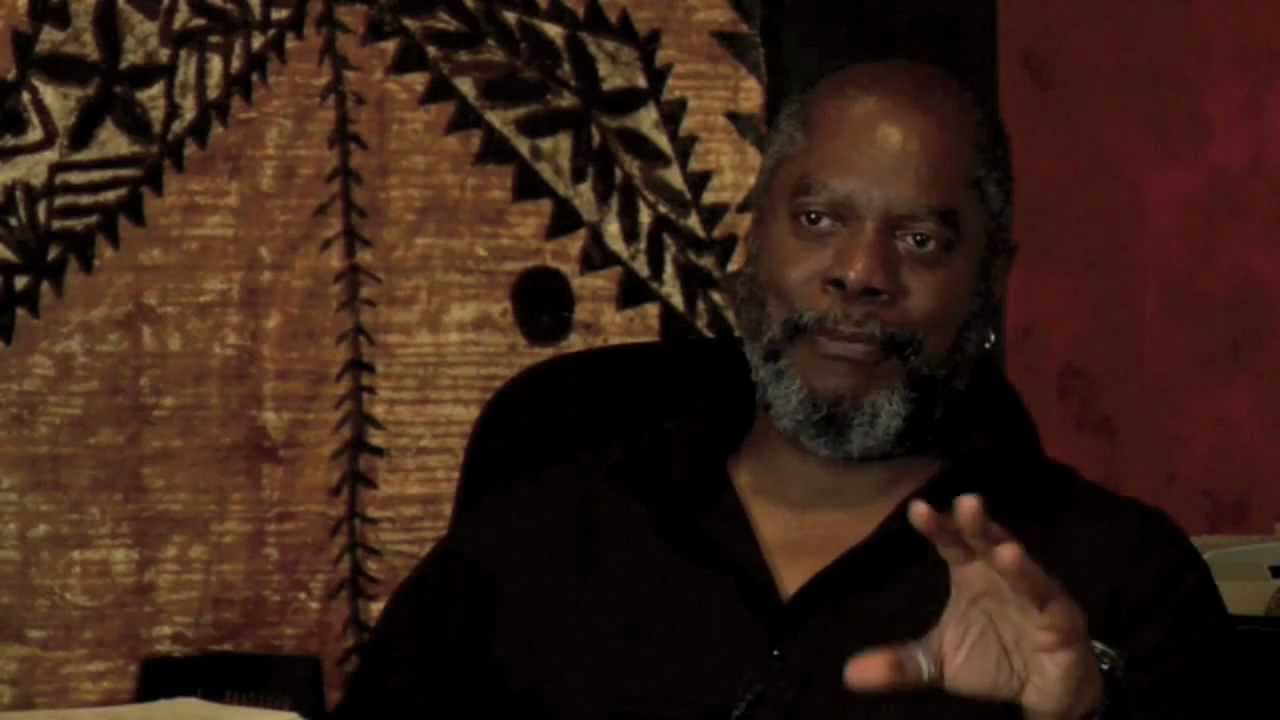
Dr. Shariff Abdullah (1951-)

Dr. Shariff Abdullah
(1951 – )
 
Green Meme

 
Accomplishments
 
+ Provided legal services for low-income individuals in North Carolina
+ Member of the Black Panther Party
+ Lecturer at many Universities including Marylhurst and University of California – Berkeley
+ Won “Community Empowerment Award” from POTUS Jimmy Carter
+ Won the “MLK Lifetime Achievement Award” from the World Arts Foundation (2009)
+ Aided in negotiating peace between the Sri Lankan government and Tamil Tigers
+ Has three daughters who all went to Virginia State University
 
Biography
 
Shariff Abdullah was born Sherwood James Sanders in Philadelphia, PA in 1951. He was reared in Camden, NJ. He relays that Camden, NJ was severely economically depressed. His family could not escape economic hardship. He was able to read at eight years old, and his mother had to apply for public housing. They arrive at their new home, and Dr. Abdullah sees a sign that says “CONDEMNED.” The landlord looks at Dr. Abdullah and says “Don’t worry about it kid.”
 
Dr. Abdullah could not verbalize what he saw as wrong with his city. However, he knew he had to take action. At twelve Dr. Abdullah led a demonstration for improved housing with The Black People’s Unity Movement. His love for building his community grew, and at fifteen he aspired to be an Episcopal priest. Unfortunately, he saw the Episcopal Church do nothing to improve the actual living conditions of people, especially black people.
 
In college he converted to Islam, a religion he stayed in for fifteen years. He decided to leave the religion when he went to Friday prayer and said a man wearing a t-shirt that said: “Kill them all let G-d sort it out.” He saw this and voiced his disapproval. The others in the mosque had no problem with it. At this point, he decided this was not the religion for him.
 
Dr. Abdullah considers himself a Societal Transformationalist. The societal transformation he seeks happens first in individual consciousness. Dr. Abdullah integrates his consciousness with the beings around him. Once his consciousness is integrated, he can determine solutions. An integrated conciousness will remedy the root of the problem.
 
Dr. Abdullah is most know for negotiating a ceasefire between the Sri Lankan government and a rebel army called the Tamil Tigers. He worked with a Sri Lankan organization called Sarvodaya. His team was respected by both sides and was able to understand the needs of both armies. After the war was over, the organization facilitated the writing of the Sri Lankan constitution.
 
Basic Philosophy
 
Dr. Abdullah believes in creating a world that works for all beings. He recommends looking into the nature of the ideal society. Frequently, people focus on immediate problems that are mostly symptomatic. People then become dogmatic about their solution path and various camps are created. The building of these philosophic schools leads to more conflict. Those in power utilize the conflict to manipulate people for personal gain.
 
To change your consciousness, a person must first understand consciousness. There are three basic types of consciousness. The first consists of the stance that the individual is separate and above all other beings and is called “breaker” consciousness. The second consists of the stance that there is no individual, we are all one, and the one is sacred. This stance is called “keeper” consciousness. The last stance is called “mender” consciousness. The “menders” were formally “breakers” that converted to the “keeper” philosophy. “Menders” have the ability to heal the world because they have a thorough understanding of both stances.
 
Once a person’s consciousness has improved, he or she must implement their vision. Societal change does not come from protest or getting bills through Congress. It comes from fulfilling a vision. If repairs need to happen on the road, block the road and fix it. Don’t wait on the government! If anything, tell the government to improve the road by a specific date or we will. The transformers must focus on the solution. Protesting focuses energy on what is not wanted making the problem worse.
 
Dr. Abdullah is also against violence. Violence only releases anger and produces no creative energy. The non-violent stance is a one hundred and eighty-degree shift from his earlier days as a black Muslim and a Black Panther. In retrospect, he sees that the anger they inflicted on each other the anger they had for the greater society. Indulging in anger led to the organization becoming dysfunctional.
 
Shadow to Light (S2L) Program
 
The Shadow to Light (S2L) program is a group study program designed to remove emotional blockages called a shadow. Shadow, as Dr. Abdullah explains, is anything that blocks divine light. The student will eliminate these emotional blockages that cause the shadow, and their consciousness will improve. As the course progresses and more people take the course a critical mass will be reached. The planet will begin to shift at critical mass.
 
Shadow is another word for fear, and Dr. Abdullah has categorized the fear under four groups.
+The shadow of violence
+The shadow of other (racism, sexism, other aspects of other)
+The shadow of lack (poverty, greed, hoarding)
+The shadow of despair (depression, suicide, mass homicide)
 
Shadow blocks light. Dr. Abdullah has categorized the Lights under four groups.
+The light of peace and security
+The light of inclusive community
+The light of abundance
+The light of deep fulfillment
 
The removal of shadow is essential because Shadow causes most of life’s problems. Shadow keeps us small, unenlightened and perceiving reality in an incomplete way. Shadow keeps us from our best selves. As a result of so many people not living up to their full potential, society resides in a perpetual state of injustice. Insecurity, immorality, and mindlessness is the basis of the current culture.
 
The process of living causes shadows to form. Messages from authority figures and peers can make people value things that are not important or feel doom is imminent. Dr. Abdullah also discusses of shadows can be passed down in DNA. A person’s DNA holds trauma from past generations. Life circumstances can trigger the embedded trauma DNA.
 
There are many reason shadows form and linger. The first is denying that the shadow exists. Many people go through life never even attempting to deal with or understand their shadow. Personal stories also help to maintain shadow. If a person fears intimacy, he will say women don’t like him because he is poor. The individual will subconsciously sabotage his attempts to make money. The lack of money will give him an excuse to not be intimate. He will never have to face his fear.
 
The shadow to light technique is an elaborate process that takes a few weeks. The scope of this analysis can not give Dr. Abdullah’s method proper justice. However, the process involves building a sacred altar to ground a person in the shadow she is trying to remove. A person meditates on the energy and moves the energy from her mind. Then there is a closing ceremony to acknowledge the energy is out of the mind. The S2L process is the beginning of the transformation. A person will work on fully removing the shadow over many years.
 
Next Steps in Human Consciousness
 
Dr. Abdullah believes there is an all encompassing consciousness that can influence events in physical reality. He has six main precepts to this philosophy.

+All is alive
+All is conscious
+All is connected
+Mind is all-pervasive
+Consciousness is universal
+The laws of physics bend toward consciousness
 
The last point is one that he feels particularly imperative to prove. As evidence, he provides Arthur Koestler’s heat lamp experiment. He connected a heat lamp to a random number generator. If the random number generator had an even number, the light would turn on, if odd it turned off. He verified that the light stayed on fifty percent of the time by letting the random number generator cycle ten thousand iterations. Then he did the same experiment with unborn chickens under the lamp. The lamp stayed on an amount of time beyond statistical probability. Dr. Koestler repeated the experiment with an independent observer. This time there was one tray of fertilized eggs and one tray of hard-boiled eggs. The observed did not know which tray had which type of egg. The tray with the fertilized eggs had the lamp stay on an amount of time out of statistical probability.
 
He also references the Princeton Egg Experiment. In the experiment, random number generators were set all over the world. The researchers noticed the random number generators create a significantly significant amount of even numbers before catastrophic events. Noted instances of this happening were, the explosion of the space shuttle Columbia and the September 11th attacks.
 
Transcendental meditation conducted an experiment on meditation in a city. The meditation group organized hundreds of meditators to meditate at a particular time of day. Crime including murder rates dropped significantly in that hour. Confirmation for the experiment came after the experiment was repeated in many cities.
 
These cases serve as evidence that our consciousness can have an effect on physical reality and there are “other-worldly” forces he calls the Life-Energy Field, at work in our daily lives. People on a meditation path can begin to develop these powers of the Life – Energy Field. He specifically details the Five Latent Powers listed below.
 
+Collective Telepathy / Knowing
+Spatial Powers
+Temporal Powers
+Communication Powers
+Bodily Powers
 
Without going into extreme detail, he lists as sub-categories to these powers, shape shifting, teleportation, communication with plants, communication with animals, and weather control. More common latent power subcategories include changing heart rate, respiration, and power of prayer.
 
Examples of collective telepathy he sites are the knowledge of Polynesians to discover uninhabited islands. He claims that would set out to sea on canoes and know where to row. Another example of group telepathy was his ability to sing a song in a language he had never heard of before during an Ayahuasca trip. He recounts himself and a close friend being able to sing the song on key with correct pronunciation.

He also uses as evidence recounts of an ancient civilization, known as Zhangzung (500 BC – 625 AD). Zhangzung predates ancient Tibet, a culture occupying the area currently. There are many stories of the people of Zhangzung having many of the powers Dr. Abdullah calls latent powers.
 
Dr. Abdullah is aware that many people will not be able to believe the Life-Energy force exist. His contention is these people are unimportant. It is not his student’s job to convert non-believers. The goal is to grow and cultivate the people that are on board with these plans. Again, there will be a critical mass reached, and the world can move into what he calls the Third Global Civilization. Ancient cultures such as Zhangzung represent the First Global Civilization, modern man occupies the Second Global Civilization, and our glorious future represents the Third Global Civilization.
 
What he has right
 
Dr. Abdullah has a thorough understanding of shadow. The most important aspect of his work on shadow are the tangible methods for removing Shadow. He also explains how shadow holds individuals back. Again I highly recommend his study of shadow work.
 
He is correct that until people’s mindset has changed, there will be not a real improvement of the state of the world. All other measures will be partial and only affect symptoms. The world will continue to create more flowery language and predatory systems.
 
Dr. Abdullah’s view of violence is also correct. Violence always causes more problems than it solves. The anger that begets violence should be acknowledged, analyzed, and released. Working through the anger will allow your relationships to improve. Once a person has begun to progress effort should be made to bring others along.
 
What he has wrong
 
Many meditation traditions include stories of people gaining supernormal powers after decades of sustained practice. However, this does not happen frequently enough for people to compile sufficient verifiable evidence. When Dr. Abdullah talks about the latent powers in an audience of meditators of all levels he does them a huge disservice. First, beginning meditators will make it a goal to develop latent powers. If the development of latent powers is possible, only a handful of serious practitioners will attain the powers. There are enough positive benefits from meditation that almost everyone experiences. Among these common benefits, reduced anxiety and improved cognition. No reason to get people’s hopes up in developing powers they more than likely will not attain.
 
It is also important to make sure you control public opinion around your movement. When Dr. Abdullah says, we do not have to convert the “Anti’s” or the “Richard Dawkins” of the world he underestimates how people can thwart his movement. When he has youtube videos or blogs on latent human powers that non-believers and naysayers can view it, it could lead to a negative backlash. There could be a large group of people making his movement out to be a bunch of wackos. Dr. Abdullah says in one of his talks about latent human powers that “George Lucas had it right.” Many people would write him off at this statement and miss out on all the information he has to give. In short, leave talk of latent powers to people deep inside the movement.
 
Dr. Abdullah should do more work directly with black people in America. His work in Sri Lanka, Czechoslovakia, and United Nations is commendable. However, many of these other cultures have people within their culture with similar expertise. For example, Sri Lanka sends people all over the world to study. Many of these people could have provided the services that Dr. Abdullah provided.
 
However, Black Americans, especially descendants of slaves, do not get people from all over the world helping them out. Many analysts have equated the condition of blacks in America to people living in third world countries. For example, a black man in Cuba lives five years longer than his counterpart in the USA. There is no significant global outcry for our plight. Many people in foreign countries see their countryman coming to America and becoming successful and wondering why blacks are not doing the same thing. These people from outside the USA do not understand the emotional and psychological toll of generational disenfranchisement.
 
Dr. Abdullah could be especially useful due to his knowledge of New Age Spirituality. In the black community, we have many spiritual teachers that put themselves at the top of religious organizations and demand unquestioning loyalty from their followers. The members will defend these leaders no matter what level of evidence piles against them or how many transgressions they commit. Eddie Long and Malachi York are only two examples of spiritual leaders defended under all circumstances. An internally generated spirituality would be a tremendous benefit and prevent many black people from being manipulated. Most of the followers of these “hustling preachers” are genuinely looking for something greater. Not many people are telling them the answer is within.
 
In one of Dr. Abdullah’s talks, he explains how Ivy League professors came to aid in writing the constitution. These experts demanded their input be taken seriously despite not knowing much about the culture. Dr. Abdullah only lived in Sri Lanka a few years. He was able to become a major player negotiating peace and writing the constitution. If he was able to make that type of change in Sri Lanka, imagine what he could have done in his hometown of Camden.
 
Dr. Abdullah also lets the government off the hook to provide public goods. He recounts a story in which a street was damaged. Many citizens protested to get the government to repair the road. Dr. Abdullah recommended the citizens shut down the road and fix it themselves. This is horrible direction. The residents paid their taxes and are now owed a public good of functional roads. If the citizens fix the road themselves, they pay taxes twice. When a group has limited resources, they cannot afford double taxation. We must force the government to provide public goods.
 
Changing laws to be more favorable to black people is also paramount to our struggle. The ultimate end to racism will not come until people’s hearts change, but in the meantime, laws can restrain people from harming others. One example Dr. Abdullah provides is gun control. He recounts if you pass gun laws, then people will stab each other. That may be true, but you can’t stab fifty people in two minutes. Proper gun laws prevent mass shootings. Australia’s gun ban has prevented mass shooting for decades. Dr. Abdullah underplays the value of pressuring the government to act.
 
Where is Dr. Abdullah on the Spiral
 
Dr. Abdullah is firmly in the Green Meme. His philosophy concentrates on the psychological and spiritual aspects of racism. He has created particular systems to move people up the Spiral. Concrete processes to remove racism from the mind is an aspect of the struggle is not talked about nearly enough.
 
Unfortunately, like many other Green Meme individuals, he undervalues the importance of the daily circumstances surrounding black life, especially with his people, the descendants of slaves. I would like to see more articles on specific problems affecting the black community. He is all over the world helping and learning from every group of people. It appears the plight of the people he is closests to and can have the most effect on, are going by the wayside. In a color-blind paradigm, descendants of slaves get put on the back burner. Green Meme individuals love to fly all over the world to save everyone else and walk right by their countrymen.
 
Where can you find out more on Dr. Abdullah
 
The reader should check out Dr. Abdullah’s websites.
 
http://shariff.commonway.org/
http://www.commonway.org/
 
Sources
 
Most of the information in this article came from Dr. Abdullah’s youtube channel and TED Talk. Dr. Abdullah also has many blogs his website.
 
Disclaimer

 
The page above is a personal blog that is not an official Spiral Dynamics Blog. The work of Clare Graves and Don Beck is the basis for this article. For more information on Spiral Dynamics, please go to the website below.
 

http://www.spiraldynamics.net/dr-don-beck.html

An Integralist’s Defense of “Buying Black” (Ujamaa)

I am writing this in response to feedback from various Integralist on the need for a black website that focuses on Ego Development. My website https://blackleaderanalysis.com uses Ego Development Theory chiefly Spiral Dynamics (Graves, Beck, Cowan) to analysis the leadership skills of leaders with African ancestry. In this work, I will evaluate 200 black leaders and develop and Integral Theory of Black Empowerment.

I have promoted the site using Social Media. I frequently post in groups of black nationalist, black conservatives, and Integralist. All the sites have given me more positive feedback than negative feedback. I want to chiefly focus on the negative feedback that I have received from the Integralist Community.

This post will recount my experiences with “buying black.” For the rest of the article, we will refer to “buying black” as Ujamaa. Ujamaa is a Swahili word that means Cooperative Economics. For more on Ujamaa and a more detailed definition reference the work of Dr. Maulana Karenga.

I would also like to warn the reader that in this post I could say things that offend you. Understand that whatever I write is out of a deep love for the Integralist community. Being less than one hundred percent honest will be a disservice to both of us. These conversations will be difficult. However, we have to have them to lead the rest of the world to an Integral future.

The reader should understand my personal feelings on race. I do believe all people are equal. All whites are not out to get blacks. Many white people have been fundamental in blacks securing civil rights. Many white people have well thought out views on race and are inclusive. I also understand there is no scientific defense for the concept of race.

I also understand that the majority of Americans have racism deeply implanted in their psyche. Even I have been scared walking through a black neighborhood. These stereotypes and prejudices affect every aspect of life. We all must create specialized defenses to combat racism and specialized therapies to remove racism from our psyche. I do not believe anyone entirely divorces themselves from the concept of race. We can only hope to understand our racism more deeply, recognize racism quickly, and work to redress or prevent damage caused by racism.

In summary, race is not real, but racism is very real

I will provide the following definition of Ujamaa because it is important that blacks and Integralist practice Ujamaa. Ujamaa is taking special effort to spend the largest amount of your income with black businesses preferably businesses owned by the Descendants of American Slaves (DOAS). The goal of Ujamaa is two-fold.

1- Keep as much capital in the Black Community as possible.
2- Create an Economy controlled by blacks to counter racism in the economy at large
3- Develop the skills of the Black Community to make blacks more competitive in the market at large.

What is an Integral Perspective?

Next, I will detail my understanding of the goal of Integral Theory. Integral Theory is not a method to remove all labels from everyone and say everyone as an independent. Clare Graves’ work on developing a metatheory for psychology was intended to be used to allow a therapist to make specialized treatment for every individual. If someone was moving from Blue to Orange, use Freud. If someone was at an adolescent level of cognitive development, use Skinner. The point of the work was to know HOW to treat people differently. Same with Beck. Beck developed and analyzed various management theories to understand what works best in each situation. Proper management at a restaurant is not the appropriate management in a hospital and vice versa.

Here are some quotes from Clare Grave’s book The Never Ending Quest on the A’-N’ State (Integral Consciousness)

A’N’ Theme: Express self for what self desires, but never at the expense of others and in a manner that all life, not just my life, will profit. (p. 365)

The A’N’ system is triggered by the second set of human survival problems – the A’ problems of existence. These are the problems of the threat to organismic life and rape of the world produced by third, fourth, fifth, and sixth existential ways. (p. 366)

The A’N’ accepts and lives with the fact of differences, and that one is relating to people who are different and thus shows readiness to live with differences. (p.370)

His ethics are based on the best possible evidence as to what will benefit all- the majority, the needy, or the desiring is not enough. (p. 370)

An Integralist will evaluate all factors in every purchase and racism is a factor in a Capitalist economy. An integralist also believes that all people are equal and there is no scientific justification for the concept of race. Therefore, the wealth disparity between whites and blacks is the result of oppression. The lack of money reduces political power and leaves black people vulnerable to attack by racist whites. The lack of wealth and jobs in the black community leads to increased crime. The offense results in loss of life at the hands of police or other black people and job disenfranchisement due to a criminal record. So an integralist would be willing to spend more money or time to find businesses owned by Descendants of American Slaves to actively redress wrongs committed by D-Q and E-R periods of our history.

Integralist, especially Integral Capitalist, know how difficult it is to start a business. If a black man owns a business within a racist system, he must have an extreme amount of skill and ingenuity. At the very least he is confident and ambitious. These are qualities that could lead to getting superior service or goods. A black man can provide services on par or better than everyone else if given the opportunity over time. Black people must develop their skill and to accomplish that a customer needs to factor what the man has gone through into their purchasing.

An Integralist is not spending money to get the most for his dollar. Orange Meme individuals look solely at getting the most for the smallest investment. An Integralist wants to make a better world. Part of having a better world will involve giving blacks a fair chance to compete and contribute in society. Ujamaa is a method to affect the lives of blacks tangibly.

How I have benefited from the practice of Ujamaa.

I have practiced Ujamaa for all of my adult life. Ujamaa is a concept instilled in me by my parents that also practice it. I will chiefly show how Ujamaa has benefited me in the area of medical care.

I have been in therapy on and off for ten years. I have had white and black therapists. I have noticed that white therapist totally fold up if you start talking about how race or how racism affects your life. They get extremely uncomfortable. They are scared to be called racist, or they want to defend their ideas that America is not racist. The therapist’s discomfort prevented me from fully disclosing my feelings. A black therapist was able to give me the treatment I needed and improve my mental health.

I began to have back problems when living in Lusby, MD. The town has a small population, and there were no black chiropractors that I could find. So I went to a white chiropractor. My insurance only paid for twenty chiropractic visits a year. After twenty I would have to pay half the cost. My chiropractor said that I must come every week. I took the advice and began to pay out of pocket at the twenty-first visit. After two years I moved to Washington, DC.

When I arrived in DC, I was able to find a black chiropractor. I told her that I was getting an appointment every week. She said that was crazy. My back was not that bad, and I should conserve my visits. She suggested I come bi-weekly for two months then come as needed. I went to this chiropractor and eventually my back no longer hurt. She could have had me go every week and collect money from insurance, but she genuinely wanted me to feel better.

Ujamaa is not always easy. I am a somewhat persnickety person. I like to come into a doctor’s office and see the new furniture, beautiful pictures, and decor. The “vibe” and feeling of an office is important to me. I heard about a black dentist that set up his business to cater to inner city children. Tennessee, my home state, started an initiative to improve the dental health of school children. He won a grant to render dental services to these inner city kids. He used the grant to start his business.

When I heard this story from my sister, a dental assistant, I jumped at the opportunity to use this clinic. The clinic is in the inner city close to the schools that he is there to serve. I drove down. The clinic’s exterior was not desirable, to say the least. The sign had a few letters that would not light up. The building was old. I walk in, and all the furniture looked used. The building was once a fast food restaurant. They left the fast food tables and benches in the waiting room. The dental exam room was created in the area that previously was the kitchen. I sign in and wait. Then it happens. A bus load of inner city kids was dropped off to get their teeth cleaned. The kids were loud and unruly, probably no more so than I was at that age, but I was not very happy.

I am called to the back, and the dentist greets me with a smile. He asked me how my day was and I said I was fine. I could tell he is interested. He completed the routine cleaning, and we talked a little about my life. He saw from my teeth I grind my jaw at night and he wanted to know if I was stressed out. I started to talk about my job, which I hated at the time. He then fitted me for a mouth guard. The mouth guard fitting takes an extra twenty minutes. Most dentist would want me to come back on another day. He was able to truly accommodate my needs both in the dental and emotional aspects.

It has been my experience that black medical professionals are more likely to listen to their patients. They are also careful to explain things in a way that is easily understandable. I think this is because black medical professionals are more likely to interact with people without degrees in their personal life. The interaction with people from various educational backgrounds allows the professional to practice explaining difficult concepts in understandable language. Many blacks stereotype black professional as stuck up. The preconception that black professionals see themselves as superior causes black professionals to learn how to present information in a non-threatening and understandable manner. I think that all people can benefit from a doctor that can explain things in layman’s terms. The ability to speak in plain English could be a huge benefit if you are diagnosed with a serious or complicated medical issue.

How to practice Ujamaa.

A person must first fully understand Ujamaa. Ujamaa is not charity! You are not buying from black people because you feel sorry for them. You buy because you are investing in an economy that will provide a unique value to society. You will benefit from the goods and services provided by the business now, and society will take advantage of this business later. You realize black people have a unique understanding of the world that will allow the to develop unique skills. You are investing in these skills and getting immediate services or goods.

The first thing a person must do is find black businesses in their area. In America use the site http://www.blackpages.com. It is the largest directory of black-owned businesses. Locally contact your Black Business Bureau or read advertisements in the local black-owned newspaper. An Integralist should read black publications because he needs all perspectives.

If a black owned business can not be found, shop around town for a business to provide the service you want. Go into the office and look around. See if you see any black people working there. Also, notice the jobs the black people hold in the company. Are they upfront in an office or are they doing manual labor? Factor that into your purchasing decision. If you are living in a large city, almost every business should have a few black people working there. If no black people are working there, more than likely the owner is racist. If you live in a city that is 30% to 50% black, you can find someone black to provide any services.

The last point many people will say is racist. They will think you are attempting to punish a company for hiring practices. These same people will also tell you to boycott a company or store for environmental transgressions. If you heard Walmart was violating EPA regulations, every Integralist would push for a boycott. However, if you suspect a company has racist hiring practices, you don’t think anything should be done. If you are willing to use your dollar to punish environmental transgressions and not racial transgressions, you care more about animals than people.

The last thing is to use the influence you have on your job to get contracts and subcontracts to black businesses. If you get to make a decision on procuring janitorial services use a black janitorial service. If the windows need to be washed, find a black company to provide the service. You could get some flack from people above you, and there may be an issue here and there because black-owned businesses are not large. However, this is an investment in the future of America.

Conclusion

Ujamaa is a practical way to address racial injustices. An Integralist doesn’t just say he wants to end racism. He doesn’t simply repost an article by Ta-Nehisi Cotes once a month. He is using his power, influence, and money to make the lives of Descendants of American Slaves better in the here and now. Ujamaa is an Integral practice that has real world results. Sitting and talking about racial redress is not enough. Let’s take action.

For more information on Ujamaa refer to the Dr. Karenga’s website

http://www.maulanakarenga.org

He also has tons of lectures and articles available for free online. `

Website Powered by WordPress.com.

Up ↑