Search

Black Leadership Analysis

This is an unofficial Spiral Dynamics blog. It is not endorsed by D. Beck PhD.

Author

blackleaderanalysis

This site will use Ego Development Theory to analysis various leaders and problems in the black community. Ego Development Theory is a value meme classification first invented by Clare W. Graves and expanded by Natasha Todorovic, Christopher Cowan, and Don Edward Beck.

Why Equality is Necessary for Democracy

In Ambedkar’s view, three main types of foreigners that become interested in Indian politics and inequality. The first attempt to use the disparity of India to justify continued British rule. The second doesn’t know or care about the depressed classes and only wants India to be free. The third only have a passing interest in India and involve themselves only for multi-cultural effect. For the rare few that are interested in the intersection of inequality and independence, Ambedkar details difference in India hurts the cause of independence.

Foreign misunderstanding is quite understandable. Congress was the only party strong enough to have international press coverage. They can control Indian media because most of the capitalist class are upper castemen and supply all the advertising revenue for the newspaper. The monopoly on the media led to the perception that they are the only group resisting the British. Also, the press suppressed the shortcomings of Congress on Dalit issues.

Those in command of Congress despise depressed classes and want to maintain the caste system. There was one Congressman, Mr. Tilak, that said depressed classes are only to obey laws not make them. The mere notion that depressed classes should join the war effort angered Congressman Patel. All the provinces that had a population majority of Hindus had Brahmin Prime Ministers. When Congress did promote depressed class legislatures, it was done to discourage Hindu participation. They knew self-respecting Hindus would not participate in a Parliament that included depressed classes. Congress was not only fighting for the removal of British rule but the reinstatement of the ancient caste rulers.

The caste order was not just an extreme version of the stratification in all societies of the ruling and servile class. The result of the class solidification was those that governed in previous generations produced the current governors. This stratification can only be partially explained by the fact most don’t want to participate in governance. Those in the ruled class begin to form an inferiority complex that helps to perpetuate and solidify class. Because the ruling class is rarely lost power, their prestige grew. That is why adult suffrage by itself is not enough to ensure equality.

The parliamentary government replaced despotic sovereigns in most of the developed world. At the time of the World Wars, parliamentary government fell to despots in Italy, German, Russia, and Spain. The cause of regression was a disparity between rulers and those ruled. The Constitution should primarily prevent the formation of a permanent governing class. Parliamentary government, by its very nature, cannot move quickly enough to meet the needs of the servile class after the creation of significant disparities. If this class developed, the only recourse was a revolution.

Democracy requires constitutional safeguards to protect the servile class and prevent the development of a permanent ruling class. Many that are against these safeguards operate under the incorrect assumption that individuals operate with equal bargaining power. The disparity between rulers and the ruled is only one barrier to truly free enterprise. The government must act affirmatively to balance power between individuals.

Why Dalits Asked For and Needed Reservation

Mr. Mohandas Gandhi joined the Indian National Congress in 1919. He then conducted a four-pronged campaign for Indian independence from 1920 to 1942. The first pillar was non-cooperation to make government rule useless. Those Indians who did not go along with non-cooperation had to suffer social boycott. Members of Congress would not buy or fraternize with Indians not involved with the freedom struggle. There would be Civil Disobedience or protests to show the multitudes of people unsatisfied with His Majesty’s Rule to further the cause of freedom. The final weapon was the fast, welded by Mr. Gandhi himself. The fear of public backlash from the death of someone as revered as Mr. Gandhi was enough to push legislation through.

The freedom campaign was mostly taken up by Hindus. Muslims played a small role for a short time. Dalits, Indians without Caste, played little to no part. They knew if India did become independent upper castemen would control government with the lower caste serving as policemen. With a power structure of nothing but castemen, how would Dalits secure their rights? Dalits wanted safeguard for political representation and government employment guaranteed in the constitution.

The relationship between Dalits and the British began with the invasion of the East India Company. The company enlisted Dalits in the state of Maharashtra to take power away from the Hindus and install the first British stronghold. The resulting victory of the Dalits showed that divine fate did not determine their station. They can unify and overthrow their oppressors.

Dalits began to see themselves as a separate political and social entity. Hindus never questioned Dalits being a separate entity until political power was to be split between various factions in India. Now Congress is emphatic that Dalits are part of Hinduism, but in what way.

Ambedkar dissects the question of various levels. The first is in the territorial sense of those that occupy the area colloquially referred to as Hindustan. At that level, one could say Dalits are Hindus. However, at that level, Muslims and Sikhs could be considered Hindus. Both groups received accommodations for political representation in the constitution.

The next level one could answer the question is social. Do Dalits and Hindus interact enough on a social level to be considered one people? The answer is emphatical, no! Untouchability, by its very definition, precludes even contact. No reason to also ask about intermarriage, dining, or occupations. In no arena are Dalits socializing with Hindus.

The last level is as members of the religion of Hinduism. First, one must ask what Hinduism is. Ambedkar explains there is no unifying moral code or system of practice. What is commonly referred to as Hinduism is various cults with a similar origin. Many Dalits were members of these cults even though there were strong movements of conversion to Buddhism and Islam.

Even if Dalits occupy a cult of Rama, Krishna, Vishnu, or Shiva, they do not observe untouchability. There is also not enough interaction with mainstream Hindu cults to consider both cults brothers. Even if Dalits occupy the same cult as a Hindu, it would not mean they are in the same community. Indian Christians, Europeans, and Anglo-Indians hold the same religion, but they are not unified in a singular community.

Now that Dalits have established themselves as a separate community, why not grant Dalits constitution safeguards? Allowing the safeguards would build the trust and sense of brotherhood that Congress said was necessary. Indian independence would never stand without this sense of fellow feeling. What Dalits are asking for in political representation and government work is very reasonable. The alternative would be to ask for an independent country like many of the Muslims and Sikhs. If Congress does not want to grant Dalit accommodations, one must wonder if they ever intended to treat Dalits equally.

The adversity faced by Dalits is much more significant than just untouchability. They are fighting to overturn the belief built up over thousands of years. Because Dalits did not cause the belief in inferiority as ordained by a divine fate, no amount of self-improvement on the part of Dalits will rectify it. The Hindus must end discrimination. The question remains do Hindus as a collective understand the atrocities they have inflicted on Dalits and do they care to act to remedy the situation.

Growing Down Podcast 2020

Integral Stage Podcast 2020

Indian National Congress and Gandhi on Dalit Issues

In Ambedkar’s book What Congress and Gandhi Have Done to The Untouchables details the history of the Indian National Congress and their relationship with Dalits and Dalit issues. The Indian National Congress is a political party. Ambedkar ran the opposition party called the Indian Republican Party, which he named after the American political party that freed the slaves. The book provides a history and contemporary analysis of the Congressman.

The Indian National Congress (Congress) formed in 1885. Their main goal was to lobby for the full independence of India. Initially, Congress wanted to address political and social issues. However, the two goals often contradicted. When a social issue was championed people of different castes would be set against each other. The disunity weakened the party’s efforts for Indian independence.

There were two schools of thought on the subject of social reform. The first was there needed more equity in Indian society, but the political realm is not the place for it. Individuals and community organizations can improve the plight of the downtrodden. The second was that no social reform is needed at all. Over the years, Congress became less and less interested in social reform, and the subject had not been raised from 1895 to 1917. The Indian Social Reform Party took up social reform outside of Congress.

In 1917, the Depressed India Association gathered in Bombay to pass a resolution to the British government. The Dalit leaders created a resolution that stated India should not receive Independence until Depressed Classes have full rights. These rights would include access to public facilities such as schools, roadways, and water sources. Dalits should also have proper representation in government and legal protection from discrimination if Dalits don’t have full citizenship, then India should stay in the hands of the British. The Depressed Classes pledged loyalty to the British Crown before all other entities. If the Depressed Classes supported Congress’s plan for independence, Congress would have to take their issues seriously.

In response to Dalit’s First Resolution of Loyalty, Congress had to pass the 1917 resolution to improve the lot of Depressed Classes. Congress’s response was to declare that India can’t be free while oppressing its citizens.

Gandhi joined the Indian National Congress in 1919 and completely overhauled it. When he entered, it was a gathering of intellectuals that would pass resolutions and wait for the British government to act on them. Gandhi instituted an overhaul in 1922 called the Bardoli plan.

The Bardoli plan expanded membership to anyone in India for a small fee. Once membership grew to 10 million, they can advocate for the use of the spinning wheel instead of buying foreign cloth, alcohol temperance, and community-led conflict resolution. There was an effort to improve the social condition of depressed classes as part of this plan.

In two interviews in 1920, Gandhi expressed his view on the communal question. He expressed fear that the Dalits or any community asking for help from the government would be moving from the frying pan into the fire. When the government gives aid they do it to manipulate the group against the rest of India. Gandhi references Muslims and Sikhs as examples. Many Dalits wish to convert, but conversion is only a matter of the heart and has no bearing on one’s physical condition. He encouraged Dalits to aid in the effort of independence and that many in Hinduism are pushing for reform. The oppression of Dalits hurts the case for Indian independence. If Untouchables enter the cause of Swaraj, they will be more than welcome.

Congress did state they would work to improve the life of Dalits. However, little was actually done. One of the Dalit’s most staunch allies in Congress, Swami Shradhanard resigned due to Congress’s inaction. In May of 1923, Congress official requested the Hindu Mahasabha take up the issue of removing Untouchability. The Mahasabha was especially unequipped to handle the communal question. They formed as a militant response to Islam’s growth in India. The communal question would not become a priority again until after the Poona Pact of 1932.

On September 30, 1932 Congress established the Harijan Sevak Singh. The name loosely translates into the servants of the untouchables. In the official mission statement the founders are clear the goal is not to end untouchability. Instead they seek to improve the life of Dalits without rattling the social order.

Harijan Sevak Singh or Singh for short embarked on a program to improve public facilities for Dalits. The Singh supplied and aided clinics reserved for Dalits. There was also a campaign to improve water wells that Dalits were allowed to use. Scholarships were given to Dalits for high school, trade school and college. Many Dalits did benefit from the Singhs program.

Even though there was benefit to the program there would always be serious disparity if all public facilities were not open Dalits. There is no such thing as separate but equal. Those in power will always fund their facilities before the facilities of the downtrodden. There were Dalits on the board of the Singh when it began. However, once years passed and the mission never grew to include Dalits in the normal functioning of society, the Dalit leaders left. Gandhi never found replacements and said his reasoning was the curse of untouchability is the responsibility of castemen to end.

Untouchability was not a priority of Mr. Gandhi during the height of his civil disobedience campaign from 1922-1941. Congress boycotted the British government and goods. He was tried in 1922 for sedition and sentenced to six years. He was release in 1924 due to illness. There was a six year effort that began in 1935 to win access to public wells and temples. However, Gandhi never used civil disobedience against Hindus. The effort changed to simply improving water sources already segregated for Dalits. As far as temples, 142 were opened to Dalits. But of the 142 temples 121 were owner less, essentially Dalits were granted access to temples no one else wanted.

During Gandhi’s civil disobedience campaign, Ambedkar was agitating for access to Chawdar Water Tank in Bombay. The most famous of Ambedkar’s acts of defiance of caste rule happened when he gathered a group of Dalits to drink from the water tank in 1927. The Bombay campaign of 1927 included access to other public facilities such as schools. Ambedkar did reach out to Gandhi’s organization Harijian Sevak Sangh and they did nothing. In fact, they aided the Hindus in blocking legal adjunctions by the Dalits.

How Ambedkar Saved Gandhi’s Life

On November 13, 1931, a select committee of the Round Table Conference submitted the Minorities Pact detailing a plan to give Dalits weightage. Weightage is having a percentage of the vote larger than their population size. Also, there would be seats reserved in the legislature and executive cabinet for Depressed Classes. The reserved seats would be elected using a separate electorate of depressed classes. Forty-six percent of the population of India supported the resolution.

Gandhi came out in opposition to the Minorities Pact. He argued that having a specific plan for material redress for the condition of Depressed Classes would make untouchability a permanent status. Instead, untouchability should be removed by building solidarity in the independence struggle. Once British Rule is removed, Indians would naturally work together. There were many already in Hinduism that was working to remove untouchability. By improving the spiritual/psychological condition at the individual level, untouchability would naturally end. The government doesn’t need to protect Depressed classes because Hindus were serious about reform.

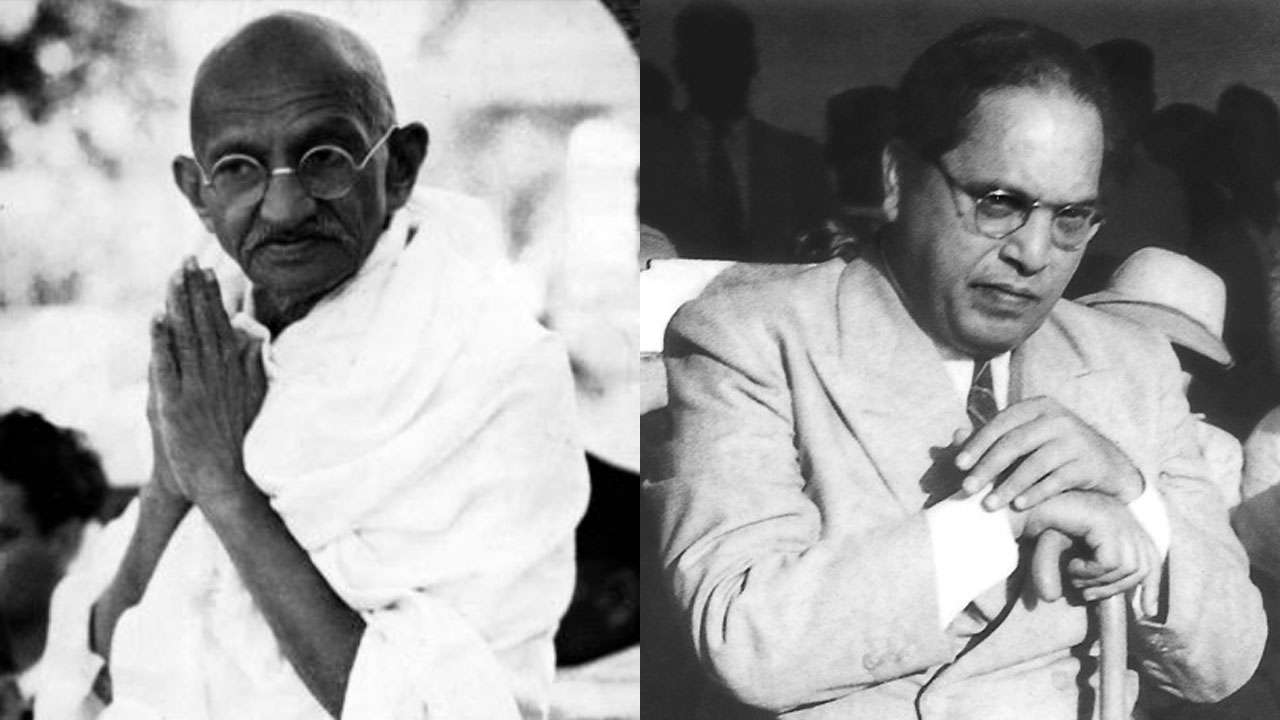
The primary advocate for the Depressed Classes was Dr. Ambedkar. He was a Dalit, one the suffered from untouchability, and became a leader in government as well as a world-renowned scholar. He was instrumental in the passage of the Minorities Pact. Gandhi dismissed Ambedkar as bitter about difficulties experienced in his own life. Ambedkar was full of unfounded suspicion and saw all Hindus as enemies. Gandhi could understand his pain because he faced similar treatment as an Indian living in South Africa in his younger years.

Instead of working with Ambedkar to absolve his fears, Gandhi chose to work behind the back of Ambedkar to get the Muslim and Sikh delegation to withdraw their support for the Minorities Pact. Gandhi submitted the Gandhi-Muslim Pact as an alternative. The new pact increased the political power of Muslims and Sikhs with no recognition of other minorities. The British government initiated the Franchise Committee to resolve the discrepancies between the two schemes. The committee began work in January of 1932.

To further undermine the Minorities Pact, Gandhi threatened to go on a hunger strike until all mentions of untouchability are removed from the Constitution. His first letter to Sir Samuel Hoare was dated March 11, 1932. Sir Hoare replied he would make no changes to the Constitution. His Majesty’s Government made the Dalit provision official on August 17, 1932. Gandhi went on a hunger strike the next day.

Ambedkar could let Gandhi fast till death. The provisions were in the Constitution. However, he knew that the death of Gandhi would cause a serious backlash, physical and political, for depressed classes. Ambedkar entered into negotiations with Congress and created a compromise called the Poona Pact. The pact ended the special electorate for Depressed Classes. However, it increased the number of reserved seats in the Provincial (State) Legislatures from 78 to 148. The Central (Federal) Legislature had 18% of its seats reserved for Dalits. The Minorities Pact reserved the seats for 20 years. The Poona Pact reduced this time to 10 years.

The Poona Pact was destructive to the politics of depressed classes. The separate electorate allowed for candidates that specifically addressed Dalit issues to win. If the candidates were chosen from general electorates, the candidate would have to appeal to the masses. In fact, a depressed class candidate could win by only appealing to Hindus in provinces with few depressed class members. The Poona Pact significantly weakened Dalit’s ability to push for their rights.

Gandhi and Ambedkar Debate Caste

Gandhi’s Vindication of Caste

After Annihilation of Caste was published, Mr. Mohandes Gandhi wrote three articles in his newspaper Harijan. In these articles, he defends his position supporting Chatruvarnya. Chatruvarnya is the belief Hindus should live out one of four ancestral callings, Brahmin(Priest), Kshatriya (Soldier), Vaishya (Retailer), Shudra (Menial). This system was far older than the caste system, which split Hindus into hundreds of sub-castes.

Mr. Gandhi begins by saying nothing in the speech was out-of-character of Dr. Ambedkar. The Society for the Abolition of Caste (Jat-Pat-Todak) should have expected such an address from him. The publishing of the speech was of great benefit to Hindus and encouraged them to read it to know how to refute Dr. Ambedkar.

Ambedkar was raised a Hindu and was part of Hindu culture. He grew disgust for Hinduism due to their treatment of “their fellow Hindus that they label Untouchable.” Mr. Gandhi said Dr. Ambedkar’s feelings were understandable. In addition, Ambedkar was correct in his assessment that the Hindu scriptures justified the discrimination against Dalits.

The question was whether all the scriptures authoritative to the same degree. For example, the Smrities have much in them that can’t be considered the word of God. One can throw them out without the foundation of Hinduism being disturbed. Hinduism created many saints and sages. Therefore there must be wisdom in the religion. In fact, many Dalit activists are fighting the caste system without leaving the faith. One can not judge a religion by the worst participants or the worst scriptures.

In the last article, a member of The Society for the Abolition of Caste explains why they initially invited Dr. Ambedkar. It was not to have a Dalit lead the conference because the Society does not recognize such a distinction. The Society asked him because he agreed with them that caste is destroying India. The Society wanted to remove the statements that Dr. Ambedkar said he was leaving Hinduism, which they felt was not relevant to his thesis or the goals of the conference.

The member of the Society also challenged Gandhi on his assumption that Chatruvarnya is better than caste. Both are divisions of labor based on birth. They both put individuals in a hierarchy. All the arguments to support Chatruvarnya can be used to support the caste system.

The rebuttal from Mr. Gandhi was that Shastras, one of the holiest books in Hinduism, supported Chatruvarnya. If one doesn’t believe in the Shastras, then one isn’t a Hindu. Denouncing the Shastras was equivalent to a Christian denouncing the Bible or a Muslim criticizing the Quran.

Dr. Ambedkar’s Rebuttal

Dr. Ambedkar begins by restating what he hoped to communicate in his speech. First, caste was destroying India. If Indians transitioned to Chatruvarnya, it would still need to be legally enforced due to it being unnatural. Chatruvarnya denies individuals their fundamental human rights of education and self-defense. India will not advance until they adopt the principles of Liberty, Equality, and Fraternity. The Hindu scriptures undergirding them must be destroyed to annihilate caste.

Gandhi’s prescription to evaluate each text and decide which ones to keep and which to discard can’t be done in a mostly illiterate population. Ambedkar also agreed with the Society that there was no significant difference between Caste and Chatruvarnya. Both forced people to take occupations due to birth not ability. Also, none of the saints mentioned by Gandhi in his articles fought the caste system. Most defended it.

The conflict between Ambedkar and Gandhi was about was Hinduism morally beneficial. It had nothing to do with judging a religion by its worst deeds. The question was whether those deeds supported by the religion. In the case of Hinduism, scripture justified the evil acts. Therefore the Hindu religion had to be discarded.

To further prove that keeping Chatruvarnya is unrealistic, Dr. Ambedkar gave examples from Mr. Gandhi’s life. The Vaishya caste produced the “Mahatma,” and he now serves as a priest. His son married a Brahmin’s daughter. His failure to follow his own beliefs is not unique. Most Brahmin do not serve as priest and, at the time of publication, there were more Brahmin retailers than priests.

Ultimately the Hindu scriptures must be discarded to annihilate caste.

Ambedkar’s View of the Civil War and Reconstruction

Ambedkar spoke on the similarities between the struggle of Blacks Americans and Dalits in India in What Congress and Gandhi Have Done to the Untouchables. Dalit is the proper name for someone that suffers from untouchability. Ambedkar named the political party he started the Indian Republican Party after the party that freed the slaves in America. He was intensely studied on issues involving Black Americans and corresponded with W.E.B Dubois, the most prominent Black leader of the day.

Ambedkar revered Lincoln but also researched his motives well enough to understand him. He mentions an 1862 correspondence with Horace Greenly in which Lincoln says his primary goal was to preserve the Union. If freeing the slaves was needed, he would free slaves. If keeping all the slaves was required, he would keep everyone enslaved. Ambedkar likened Lincoln’s conditional support for abolition to Gandhi’s conditional support for Dalit rights. Gandhi would only speak on untouchability if the cause of Indian independence required Dalit support.

Fortunately, the victory of the Union was heavily dependent on the support of black Americans. 125,000 freed slaves joined Union forces along with 80,000 freed blacks from the North. These brave soldiers fought in 450 battles. The Black soldiers faced even more danger than Whites because they would not be recognized as POWs and sent back to slavery. They also received less pay from the Union forces until 1864. Thirty-seven thousand black soldiers fell to preserve the Union.

Once the war was over, the government understood that constitutional safeguards were needed to ensure the freedom of Blacks. The 13th amendment ended slavery, and the 14th amendment provide birthright citizenship to all Americans. Finally, the 15th amendment outlawed discrimination due to color. The American Congress passed the Reconstruction Act to facilitate the re-entry of rebelling states. All southern states must frame a new constitution and ratify the 14th amendment.

The old southern powers did not take this lying down. The Ku Klux Klan was formed to terrorize Black citizens. The southern governments instituted the Grandfather Clause that state one could not vote unless their grandfather could vote. When Blacks went to the court to fight the Grandfather Clause and get protection from Klansman, the government abandoned them. The North was not ready to re-engage the South in war. Their state in society steadily declined after the government abandoned Black people.

Both Black Americans and Dalits needed constitutional safeguards and a specific plan of redress. Ambedkar fought for Dalits to have access to all public facilities, including water resources. When India was transitioning out of British rule, Ambedkar proposed and won a special electorate with reserved seats in parliament for Dalits. His most impressive and longest-lasting accomplishment was a mass conversion of Dalits into Buddhism. As a matter of self-respect, one could not stay part of a religion that views them as inferior. The conversion to Buddhism was a recognition of Dalit humanity.

How Gandhism hurts Dalits

Gandhism is the name given to the philosophy of Mr. Mohandes Gandhi. He never admitted to fathering a new philosophy, but also didn’t object to the publication of books entitled Gandhism. Ambedkar used Gandhi’s speeches, published interviews, and the book Hindu Raj to define Gandhism.

The return to the village and ancient life served as the center for Gandhi’s philosophy. It was not a plan for modernization. He was only against the caste system due to its complication and formation of hundreds of castes. Gandhi supported the Varna system that had only four castes: Brahmin (Priest), Kshatriyas (Soldiers), Vanias (Retailers), and Shudra (Menials). Those without Caste, Dalits, would be added as a fifth caste. There would be no untouchability observed. So if someone interacted with Dalits, they would not need to be cleansed. Dalits would keep their hereditary occupations, including sewer cleaning. So Gandhi was for the replacement of the caste system with the Varna system. He did not support the equality of Dalits.

Gandhi saw the caste system as no worse than any other societal stratification. All societies have rules. Intermarriage between castes are outlawed no differently as a marriage between relatives is outlawed. All societies set limits around enjoyment to prevent the community from devolving into chaos.

The varna system is superior to the caste system because it prohibits no caste from learning or conducting any tasks. It only prevents one from earning a living in any other profession than that prescribed by one’s caste. Because no one can change their profession, there is no reason for class war or struggle.

Gandhi is opposed to unionization or collective bargaining in anything other than extreme circumstances. A strike should happen only with a “real” grievance. Those participating in the strike should live on savings or temporary work. They should not ask for donations or charity. Also, they must make their minimum demand know from the beginning of the strike. So with criteria such as these, it would be challenging for unions to be effective.

The overreach of capitalists was common. Gandhi admitted this. However, he thought workers should show restraint when addressing these grievances. The use of violence was out of the question. The laborers should remember that the capitalists have strength and intelligence. Their guidance was vital.

Machinery is another evil in Gandhi’s view. It removes man from his work, making the body idle. He also said “I would not weep over the disappearance of machinery or consider it a calamity.” If people serve in their caste profession, there will be more than enough labor and no need for machinery.

If India adopted Western values, their culture would dissolve. In Europe, the is suspicion around all the interactions between groups. Workers distrust company owners. French distrust English. Catholics distrust Protestants. Almost all members of Western Civilization are miserable. Indians must hold on to their culture not to be swept up in misery.

Ultimately, there is nothing wrong with the disparity in Indian society, only the perception of disparity. Instead of being angry that Shudras can’t accumulate wealth, praise the Shudras for not being materialistic. Instead of being jealous that only Brahmin can make a living in academia, say that they were the burden of becoming learned for their people. Most importantly, the Dalits profession of manually cleaning sewers was the noblest profession of all. This profession was ordained by divine fate as all others were. Never mind if most Dalits hated the job or had potential far greater than scavenging.

Ambedkar rebuts by making clear that caste divisions are more stringent than class divisions. Caste is the complete separation of individuals by birth. There is no way to improve one’s lot in the caste system. One can work hard and climb socially in Europe. Forcing people to hold an occupation by birth is an anathema to an industrious society.

Machinery and modernization are vital for the development of culture. When people have the burden of work lessened, time is freed for the development of culture. Man is separated from animals by his ability to build a culture. The growth of science, art, and philosophy is the foundation for a more equitable society.

The main discrepancy between the philosophy of Ambedkar and Gandhi is :

“Is it natural that a group of people solidify to govern society in perpetuity?”

or

“Is the creation of a ruling class the result of a dysfunctional society?”

Ambedkar emphatically sides with the latter. There needs to be a specific plan of redress to funnel resources into underprivileged communities. Gandhi only wanted to lessen the burden of the servile class while keeping society stratified.

Website Powered by WordPress.com.

Up ↑