Search

Black Leadership Analysis

This is an unofficial Spiral Dynamics blog. It is not endorsed by D. Beck PhD.

Author

David Hartful Jr.

This site will use Ego Development Theory to analysis various leaders and problems in the black community. Ego Development Theory is a value meme classification first invented by Clare W. Graves and expanded by Natasha Todorovic, Christopher Cowan, and Don Edward Beck.

Yellow Meme (Knowing / Connecting)

Characteristic Thinking: Big picture views, Integrative Structures, Naturalness of chaos, Inevitability of change, Systemic linkages

Decision Making: Highly principled, Knowledge centered, Resolves paradoxes, Competence based, Focus on outcomes

Educational Approach: Becomes self-directed, Whole-day package, Attuned to interests, Non-rigid structures, Diverse idea sources

Family Structures: Shifting roles, Expects competence, Takes each as is, Information based, All contribute as one can

Community Forms: Wants more thru less, Appropriate technology, Authority is dispersed, Rebuilds what works, Sustainable changes

Life Space Norms: Living is learning, Intrigued by processes, Freedom just to be, Rarely fearful or driven, Appreciates variability

From Foundation Stones: Bedrock Belief Systems that Shape Character, Community, and Country

Leaders in the Yellow Meme

Shelby Steele

Dr. Zenju Earthlyn Manuel

Dr. Bhimrao Ambedkar

Dr. William Cross

Thomas Parham PhD

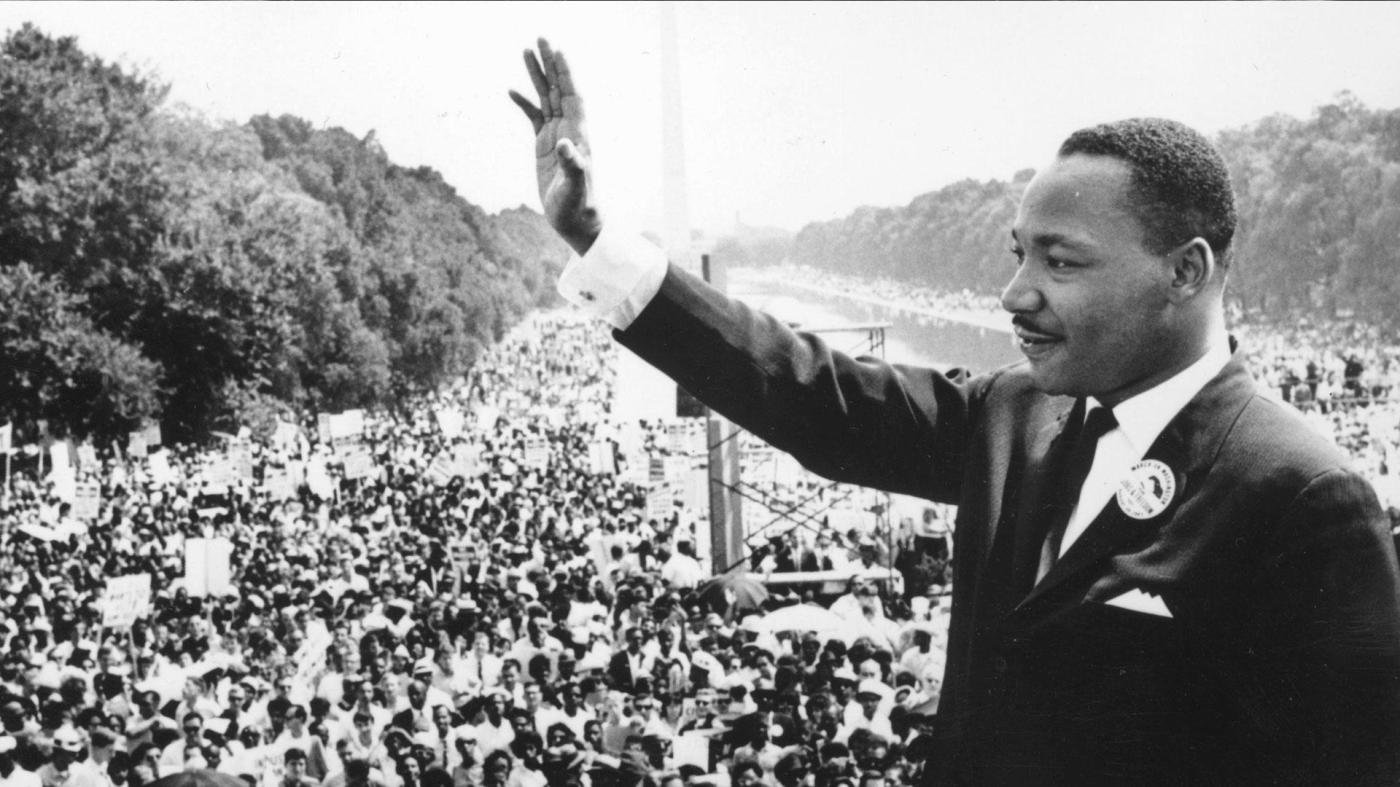
Dr. Martin Luther King

Dr. King is the most famous black American leader. Many have criticized and complimented him. Here is the site work on this leader.

Dr. King moving from Orange to Green

Gandhi’s Influence on Dr. King

Dr. King and Malcolm X Agree on Kennedy’s Death

Was Dr. King A Republican?

The Government Surveillance of MLK

Dr King in Four Quadrants

Was Dr. King Green Meme?

Dr. King and Ambedkar Agree on Communism

Did Dr. King Evacuate the “Burning House”?

MLK Library

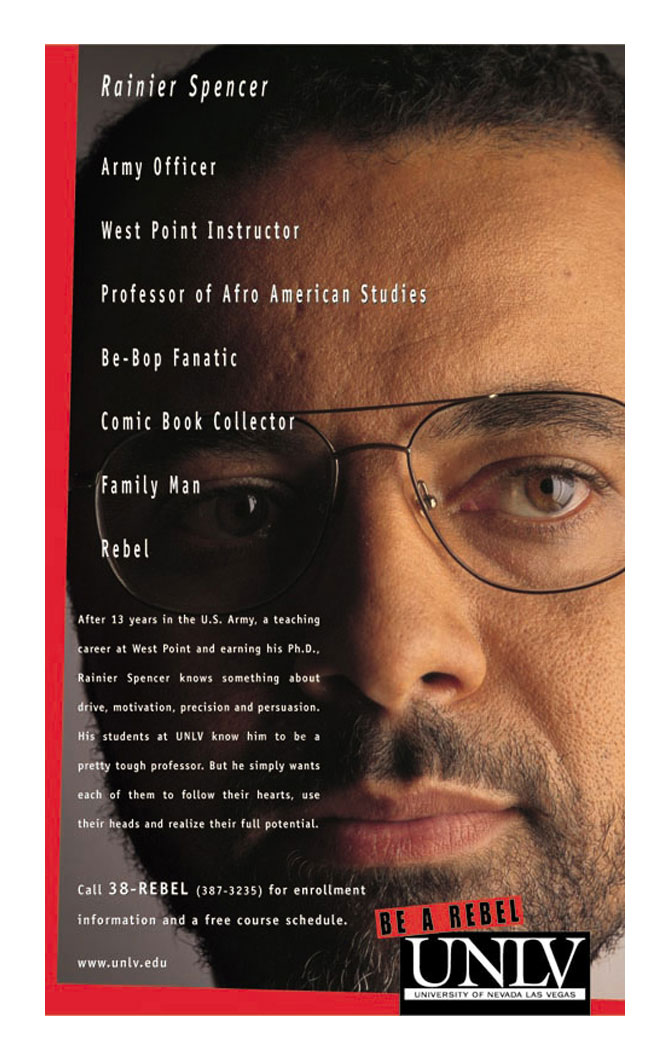
Rainer Spencer

A true rebel of Black Studies. His journey began in Hollis, Queens and currently has him stationed at the University of Nevada Las Vegas. He created the concept of Racelessness, the idea that one can see themselves as not having a race, yet understand how race affects day to day life. His commitment to black people is second to none. Below is a summary of his philosophy with an analysis.

Biography & Philososphy

Rainer Spencer Analysis

Rainer Spencer Analysis

What Rainier Spencer has Right.

He makes a reasonable and articulate case for racelessness. He also doesn’t use racelessness as a way to distance himself from other black people or the struggle for racial justice, quite the opposite, racelessness adds to his commitment. He also understands how multiracial people can be used to hurt other members of the black community. He actively identifies the mechanism that could pit multiracial black people against monoracial black people.

Spencer does the work that most people that consider themselves allies of black people should do. He understands the ways that his struggle is similar and dissimilar to that of monoracial black people. He then can see how he and other multiracial people can help and hurt the plight of the race as a whole. When building alliances, frequently the base of the union is an emotional understanding that both groups are disadvantaged. If members of the alliance could honestly dialogue to understand in what ways their struggle is similar, dissimilar, and divergent alliances among disadvantaged groups would be more stable and advantageous for both groups.

An alliance that could benefit from a more logical approach to commonality is the alliance between black and Latin people. Both groups are disadvantaged, yet the ways they are disadvantaged is very different. Blacks are disadvantaged from being economically isolated for the majority our time in this country. Latins are disadvantaged because of language barriers, unfair immigration laws, and the perception of being foreign. If a more nuanced look at our struggles were taken, we would see that many policies that help Latins hurt black people. For example, mandating grant application be available in Spanish and English. If the applications were English, only black people would have an advantage. Also, requiring job applicants be US citizens will help black people, but hurt many Latins. If both groups were more honest about what they need on a concrete level, when the racial groups decide to work together we would be more productive and fruitful.

What Rainier Spencer has Wrong

The HeyReb! mascot does allude to the Confederacy. The assertion that critics are assuming that HeyReb! is a Confederate simply because of his race and hat is absurd. The mascot cannot be taken out of context. The area Las Vegas was founded in was part of the Confederacy. The students did have a Confederate subculture for twenty years. In addition to this Las Vegas was segregated for many years and there were numerous racial incidents in the area. UNLV should remove any connection or possible connection to the Confederacy.

In the report, he says that the University has a deep connection with the nickname Rebels that could not be broken. If this is true, the school should just put changing the nickname to a vote. If people can not part with the Rebels nickname, the name will be safe. In Spencer’s report, he claims that UNLV is one of the most diverse campuses in America. If this is true, it would be difficult to believe that most students want a mascot that could in any way be linked to the Confederacy.

The Rebels report was very incomplete. It only used face to face interviews and articles from the school newspaper. First, the school newspaper has an incentive to play down conflict and animosity, due to the fact the newspaper answers to management at the school. If they print negative stories about the school, the administrators could cut funding or pull students scholarships. Second, face to face interviews could make interviewees feel uncomfortable when giving a dissenting opinion or relaying a negative story. For example, Spencer said only one member of the Black Student Organization expressed a problem with the flag. However, they were talking to a faculty member sent by the administration to determine if the school mascot needs to change. It could be they were afraid that they would be targeted or punished for expressing a negative opinion.

The information on Bill Casey, UNLV quarterback in 1968, shows bias that could play out due to a face to face interview. Bill Casey is black and was the quarterback for the UNLV Rebels when they had a Confederate flag on their helmets. Casey claims he never felt uncomfortable and his teammates said nothing racist in front of him. However, in a 2007 interview with the Las Vegas Sun, Casey reveals the UNLV allowed Casey an extra year of eligibility in spite of an ankle injury. If he had not gone to UNLV, he would be eligible for the Vietnam draft. The fact he did not say there were incidents of racism does not mean that he genuinely was not bothered or it is true no one made him feel uncomfortable. Giving this extra information opens the possibility that he looked the other way when racism surfaced because he had few alternatives. Also, if he did experience racism and did not fight back, it could be very embarrassing to retell the story. Not only will Casey have to relive the incident in his mind, but he could also feel he loses face in front of another black man that expected him to stand-up to oppression.

The study of UNLV’s mascot should have included anonymous surveys, and interviews with people accepted to UNLV but did not go. Spencer could have added both of these items to his study. Anonymous surveys will allow him to get a much more honest opinion of what people thought about the mascot. Interviewing the people that turned down UNLV could show how the mascot is affecting people’s decisions to go to UNLV. Even if people at UNLV like the mascot they should be aware of how much they are losing by keeping it. If Spencer presents the information that numerous star athletic recruits turn down the UNLV because of the name, they can determine if the cost outweighs the benefits.

Where is Rainier Spencer on the Spiral

Dr. Spencer is in the Green Meme. He attacks the concept of race opening the possibility for new groupings to form and unity with people of multiple “races.” He facilitates moving beyond race while realistically maneuvering in society. He understands race is not real, yet the effects of people’s perception of race have a real impact. As more people come to the “racelessness” view, what is considered “in group” expands from the blue meme concept.

Understanding “racelessness” is an I Space solution. Since “racelessness” is core to Spencer’s philosophy, this analysis has determined the “I Space” is where his solutions concentrate. His commitment to “IT Space” solutions such as Affirmative Action and taking racial demographic data shows his ability to embrace multiple solutions paths. His flexibility is a sign of Integral thinking.

Dr. Spencer did not express any need for revolution. Therefore he concentrates on First Order Change or change within the system in place.

For entire series on Rainer Spencer click:
HERE

Sources

  1. Ron Kantowski catches up with Bill Casey, who only played one season at UNLV but nonetheless remains one of the program’s top quarterbacks by R. Kantowski 10-22 -2007 http://www.lasvegassun.com

Rainer Spencer Biography & Philosophy

Accomplishments

  • Vice Provost for Academic Affairs, University of Nevada, Las Vegas (UNLV)
  • Associate Vice President for Diversity Initiatives & Chief Diversity Officer, UNLV
  • Founder and Director, Afro-American Studies Program at UNLV
    Journal of Critical Mixed Race Study Editor
  • Contributor to Mixed Race Studies.org
  • Contributor to New York Times, CNN, and The Chronicle of Higher Education

Rainer (pronounced Rie Ner) Spencer was born in Hollis, Queens. He lived in what was a predominately white neighborhood in his younger years that transitioned into a black neighborhood by the time he was in high school. His father was black, and his mother was white. He joined the army and taught basic logic at West Point.

It was at West Point he began to question the concept of race. He realized that the concept of race, a biological connection with people of the same skin color, made no sense. He then decided to personally not identify with race while being aware that society perceives him as black. Knowing that society perceives him as black, inspires him to advocate for others that are perceived the same way.

While getting his Ph.D. in 1996, he participated in the Multiracial March on Washington. The chief issue was getting the government to allow multiracial people to mark more than one checkbox on government data sheets. He also began to dialogue with other multiracial people on the Interracial Individual’s (II) e-mail list.

Rainer does not believe in race. It has no concrete basis in science. Therefore it does not exist. He calls his stance racelessness and differentiates the stance from colorblindness. Colorblindness is looking over race without actively working to redress inequality or attempting to help the downtrodden. Racelessness is the belief that race does not exist, yet the concept of race has a very prolific effect on society. Racelessness is coupled with constant advocacy to remove the stain of racism in society.

Part of his activism causes him to mark “Black / African-American” on census and government forms. The government takes racial demographic information on these forms to aid in creating Civil Rights policy. By checking “Black / African-American,” he supports the government’s research on the perception of race and how it affects socioeconomic status. Spencer does not chastise other multiracial people that check all the races of their background or multiracial people that only check “White.” He feels the question should be changed to “How are you perceived” instead of “What is your racial background.”

Rainier Spencer does not believe multiracial identity or an increase in the number of multiracial people will dissolve America’s color lines. The only way to fix the racial problem is the abolition of the notion of race. The elimination of the idea will only come after serious work is done on the collective and individual levels regarding race and the redress of inequalities. In fact, the idea that a person could be multiracial strengthens the concept of race.

It is also a fallacy to think multiracial people will act as a bridge between different races. The idea of mixed race people acting as racial bridges is rooted in the idea that people are instinctively connected to race. There is no scientific evidence for this claim. Also, being closely involved with a person for a long period does not necessarily allow the integration of perspectives. Even if proximity allows a person to take on another’s perspective, working with someone closely, social interaction, and living with a person outside of a romantic relationship (roommates)could accomplish the same goal. Ultimately, the idea that multiracial people act as bridges further marginalizes mono-racial black people. The foundation of the concept of multiracial bridging is the presupposition the mono-racial black people are not capable of speaking for themselves or interacting with society.

If a person is multiracial, then both races that the individual claims are valid and exist. The only reason to make an issue of the racial status of each parent would be to distance themselves from the lower status parent. The idea of whites at the top and blacks at the bottom of a racial hierarchy is still reinforced. People of a multiracial background will not act as a bridge between races because they will aspire for white acceptance.

Having a multiracial checkbox on standardized tests and educational documents will be used to mask racial disparities. First, the multiracial checkbox will break continuity with historical data. The discontinuity will render historical data on racial disparity useless. It will also falsely equate people that do not have the same experiences. For example, a person that has a white parent and an Asian parent will be grouped with a black man that wants to acknowledge he has a white grandfather. Their experiences will be different and will be hidden under the success of people that are multiracial and not black. The category will always fall in the middle of statistical analysis not telling researchers anything.

Mainstream media purposely misleads the public on the impact of multiracial people. A CNN documentary reported that the multiracial population of Mississippi had grown 50% from 2000 – 2010. They did not report that multiracial people are only 1.1% of the total population of Mississippi in 2010. Most articles and documentaries in the media focus on the opinion of high school and college-aged multiracial people to counter actual scholarly studies on race. The idea is if the public stops talking about race these multiracial children will lead us into the post-racial America.

The mainstream media wants to push the idea of the Conservative Consensus . The Conservative Consensus is the idea race does not make an impact on outcomes or group disparities. No collective redress is needed, only proper personal choice and education. These multiracial children choosing to not identify with either race show us that race is simply a choice. Everyone should simply get on board and stop complaining.

Spencer created the Journal of Critical Mixed Race Studies to publish and gather scholarly articles on multiracial identity. The journal publishes the best scholarly articles on multiracial identity from all over the world. Spencer hopes to counterbalance the media portrayal of his people.

UNLV “Rebels” Mascot

After the Charleston Massacre in 2015, the University Of Nevada Las Vegas reevaluated their mascot and nickname. It is currently a Pathfinder in a red suit and gray hat. The nickname of the team is Rebels . Many people believe the name eludes to the Confederacy and slavery. Spencer conducted research and interviews from August 15th to November 18th of 2015. He also reviewed over 20 years of school newspaper articles.

His research determined the name “Rebels” predated the use of Confederate imagery. It alludes to the university’s struggle for independence for the University of Nevada Reno that was obstructed by the Nevada state legislature. People in the northern part of the state controlled the government. The obstructionist pattern in the legislature has been going on since the Las Vegas region was added to the state of Nevada in 1867, three years after statehood. Las Vegas is located in an area that was part of Arizona territory. Arizona aligned itself with the South in the Civil War. [1]. No evidence could be found of battles in the Las Vegas area. Spencer also doesn’t mention in his paper that the area Las Vegas is in was part of Confederate Arizona.

The name “Rebels” was used informally to describe UNLV students since inception according to Spencer. The student body adopted a cartoon wolf dressed in Confederate uniform namedBeauregard the Wolf in the early 1950’s. His image is still in the original basketball stadium now used as an art museum.

There was far more Confederate symbolism than just the mascot. The school newspaper was called “The Rebel Yell” and featured a Confederate flag on the cover. The students would have a Confederate Cotillion that crowned a Southern Belle. The student government was called the Confederate Students of Nevada Southern. Spencer contends all the Confederate imagery was due to people not fully understanding what the Confederacy stood for in the 1950’s.

Student protests and a race riot in Las Vegas resulted in the removal of Confederate symbolism in the 1970’s. The student body was allowed to vote on the mascot and the nickname. The student body chose to get rid of the mascot and keep the Rebel’s nickname. They are replaced briefly with a Colonial soldier and a UNLV Sun. These mascots were not salient, and in 1982 a mascot committee was formed. The result is the current mascot HeyReb! aka Mr. Reb .

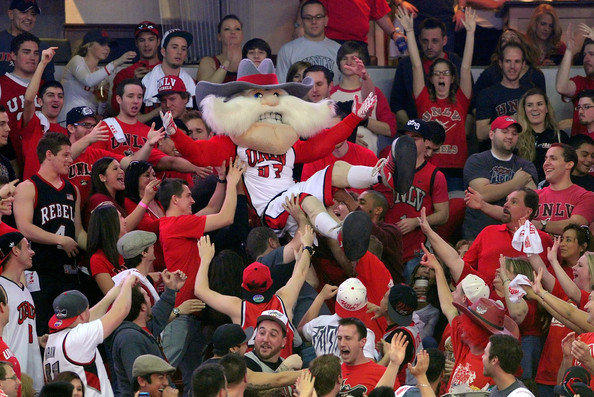
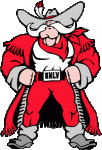
The official school stance is that HeyReb! was a 1800’s pathfinder or trailblazer. His clothing is Western, not Southern. He is depicted in a red coat and gray hat. However, when HeyReb! is displayed on clothing and logos he only has his gray hat. This leads most people to assume he is a Confederate. The school is adamant this is not the case, and a detailed investigation will lead anyone to the official school position. In fact, to assume that a white man in a gray hat must be a Confederate is in itself racist.

For the entire series on Rainer Spencer click:
HERE

FOR MORE ON DR. SPENCER

Mixed Race Studies

Rainer Spencer’s UNLV Link

Rainer Spencer’s Amazon Link

Sources

  1. How The States Got Their Shapes from the History Channel
  2. ”Mixed People Natural Bridges to Racial Healing Utopia?” Mixed Race Radio 09-04-2013 http://www.blogtalkradio.com
  3. Multiracial Identity on The Agenda with Steve Paiken 07-22-2011 TV Ontario
  4. ”Even discussing ‘angry black man’ stereotype provokes anger” by J. Blake http://www.cnn.com
  5. ”Mixed-Race Chic” by R. Spencer The Chronicle of Higher Education
  6. ”Racism and the Multiracial Check Box” by R. Spencer http://www.nytimes.com
  7. Excerpt of Chapter 9 of Reproducing Race: The Paradox of Generation Mix by R. Spencer
  8. “Only the News They Want to Print”: Mainstream Media and Critical Mixed-Race Studies by R. Spencer Journal of Critical Mixed Race Studies
  9. Bill Casey Interview with Ron Kantowski for Las Vegas Sun 10-22-2007
  10. ”Raceless like me” by Z. Weinberg http://www.crimson.com
  11. “Sanita Jackson Show with Rainier Spencer 02-16-2011 WVON AM Chicago
  12. Dr. Rainier Spencer guest on Mixed Chicks Chat Episode #131

Ole Miss Shows How To Remove Confederate Symbolism

The University of Mississippi colloquially referred to as “Ole Miss” has a complicated history around race relations. The school nickname is the “Rebels, ” and the old school mascot was a slender southern gentleman that resemble a plantation owner. Ole Miss made national news in the 1960’s when a riot broke out after James Meredith was accepted. Most recently a noose and Confederate flag were placed around the neck of his statue.

At the same time, Ole Miss has stopped the flying of Confederate flags, playing of “Dixie,” and replaced the southern gentleman mascot with a black bear. Ole Miss is showing how to make forward racial progress in a very sensitive racial environment. The process is slow, and many in Mississippi are fighting for their Confederate symbols, but the university presses on. Their method is moving the ball forward without causing a violent backlash.

History of Ole Miss Rebel Mascot and Race

The University of Mississippi was founded in 1848. In the school’s charter, the purpose of the school was to educate the white race. The school’s nickname is Ole Miss, which is also what slaves called the master’s wife. The Civil War broke out in 1861, and the student body did not want the citizens of Mississippi to fight without them. The entire class of 150 men formed Company A of the 11th Mississippi regiment. This troop fought with the army of Northern Virginia and was in some of the most famous battles in the eastern theater. The most famous battle was their last. Pickett’s Charge at Gettysburg resulted in the annihilation of the troop. This advance was the furthest the Confederacy got into Union territory. The troop was forever known as the University Greys .

The Ole Miss sports teams had no official name and had been known by many names including the Oxfords, the Mighty Mississippians, and the Southerners. A poll of Mississippi sports writers picked the name “Rebels” in 1936. The mascot “Colonel Reb’ was made after that. Colonel Reb is also an award given to the most distinguished man of campus every year. The female equivalent is “Miss Ole Miss. These traditions started in 1940.

Some say the inspiration for the Ole Miss mascot was a blind peanut vendor named James Ivy. Ivy, known around Ole Miss as “Blind Jim.” He was a fixture at football games for sixty years. An on-the-job accident blinded Jim as a teenager. He found work at Ole Miss selling peanuts after the incident. He was known to scream the loudest at the games and is quoted as saying “He never saw Ole Miss lose a game.” The university honored him with a tombstone and the marching band spelling Jim during a halftime in 1964. [7] The university has never officially connected Blind Jim to the old Mascot. Also, the mascot is white and Jim Ivy was black.

The band first started playing the song “Dixie” in 1948 for the centennial anniversary of the school.[1] The same year the Dixiecrat political party was established. The party was created in response to the executive order to end segregation in the military. The Dixiecrats were officially Democrats, but did not support integration. They were mainly from the South and fought to stop civil rights leaders. They also encouraged the use of Confederate symbols and flew the Confederate battle flag at their national conventions.

In 1962, James Meredith applied and was accepted to the University of Mississippi. However, when the registrar found out about his race, his acceptance was revoked. Meredith was able to sue citing the recent Brown vs. Board case, and a federal order reinstated his admission. When he got to the registrar to sign up for classes the Governor blocked his entrance. A second court order found the Governor in contempt. US Marshals escorted Meredith in the building to register for class.

Once word got out that Meredith had completed registration a violent mob formed on campus. A riot broke out that took 30,000 Federal troops to squelch. The riot left two people dead and three hundred injured. Today there are bullet holes in the student union building from this riot. One of the events that led to the riot were fiery speeches about southern heritage and pride.

The 1970’s were a fascinating time at Ole Miss. In 1975 the first “Colonel Reb” award was given to a black man, Ben Williams. Williams would go on to the NFL after being Ole Miss’s first black football player. The first depiction of Colonel Reb on field or court was in 1979. The mascot would not only perform at Ole Miss games but NBA games as well.

The Colonel Reb mascot has always hurt recruiting at the University of Mississippi. The first attempt to remove the icon happened in 1997. A group of students formed to support Colonel Rebel. The effort led to Ole Miss keeping the mascot. Ole Miss has not won a SEC Championship in football since 1963. Ole Miss has also never won a men’s basketball regular season title.

In 2003, the Associated Student Body Judicial Council decided to retire the Colonel Reb logo. There was a contest to pick a new mascot and a poll for students and faculty to choose a new mascot. The contest and poll got little participation. The school received 2,400 responses from 40,000 eligible to vote. [15] The school was without an official mascot for seven years.

The same year the “Colonel Reb Foundation” (CRF) was formed. In the About Us section of the website, they claim the removal of the mascot was a unilateral decision by the chancellor and athletic director. The student body and faculty did not get a say in the change. Now many Colonel Reb supporters wear a “Colonel Reb is my mascot” sticker on game-days. CRF also propagated the story of Blind Jim to explain the mascot is not racist. However, having to change Blind Jim’s skin color to white and the school not confirming the story is in itself racist.

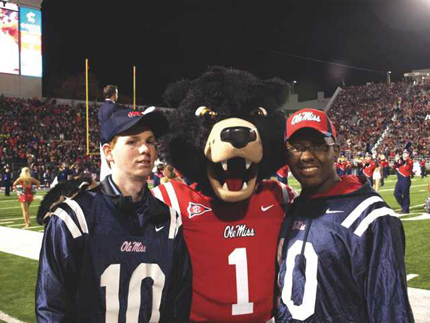
In 2010, the students, alumni, fans, and faculty chose the Black Bear as the official mascot. It alludes to Ole Miss’s greatest Alumni William Faulkner. Faulkner comprised a short story named “The Bear.” Also, Mississippi has an endangered Black Bear population. The new mascot will raise awareness on the issues of rebuilding the endangered population. Children that go to the game love the bear according to most reports.

Ole Miss Bear

After the reelection of Barack Obama in 2012, a group of 400 students assembled in front of the student union in protest. The crowd lit signs on fire, yelled racial slurs, and two people were arrested. Many have referred to this incident as the “Ole Miss Riot,” however the school has denied it was a riot.

In 2014, Graeme Harris defaced the statue of James Meredith. He placed a noose and the old Georgia state flag that depicted the Confederate flag on the statue. The incident got national attention, and Eric Holder denounced the action. In 2015 Graeme Harris was charged later that year by federal authorities. Harris was a former Ole Miss student.

Plaques were placed on building built by slaves in 2017. The school recognizes its racist history and is making concrete steps to acknowledge it. They also removed the name of a white supremacist governor from a building on campus.

On September 18, 2018, the student body president announced there will be an upcoming vote for a new mascot of a Landshark. The Chancellor of the school Dr. Vitter says the Landshark does not threaten the “Rebels” nickname. The Landsharks originates from defensive football players putting the hand on the forehead after a big play. The Landshark gesture was turned into a mascot that lost to the Bear in the 2003 vote. The Chancellor says the Ole Miss teams will always be referred to as the “Rebels”. The new mascot was announced on October 6, 2017 and will first appear in 2018. The design of the mascot is currently underdevelopment.

How is Ole Miss an example

Ole Miss is working to make concrete steps for racial reconciliation in spite of a complicated history on race. There is racial backlash on campus. However, they never stop working toward making a more inclusive campus. Many other schools and municipalities will go through a similar struggle.

One of the best aspects of this reconciliation is the Col Reb Foundation (CRF). The CRF is providing a constructive, non-violent outlet for people to voice their opinion on the changing of the mascot. Some people will have a deep emotional connection to the old mascot. Transitioning for these people will be difficult and having a support group will prevent these people from acting out.

Ole Miss will never be able to stop individual students from doing despicable things. However, they do support the investigations and convictions are made. There is work on campus to move people past the events. Also, forward racial progress is not stopped by isolated racial incidents.

Sources

  1. ”For Ole Miss Sports “Dixie” is dead by A. Ganucheau http://www.mississippitoday.org
  2. ”Controversy Over Mascots at Ole Miss” by R. Brown http://www.nytimes.com
  3. Did University of MS students really riot over election results by. J. Kim http://www.newsfeed.time.com
  4. Former Ole Miss Student Charged with Placing Noose on. J Meredith Statue by M. Muskal http://www.latimes.com
  5. Meet Blind Jim Ivy by E. Smith http://www.newsolemiss.edu
  6. Ole Miss Post Signs to Acknowledge Building Built by Slave Labor by Z. Blay http://www.huffingtonpost.com
  7. Oxford Olden Days: Blind Jim Ivy, Honorary Dean of Freshman by J. Mayfield http://www.hottytoddy.com
  8. The University Greys http://www.hottytoddy.com
  9. Integrating Ole Miss: A transformative Deadly Riot by D. Elliot http://www.npr.org
  10. Riots of the Desegregation of Ole Miss http://www.history.com
  11. Ole Miss will be recognizing the campus was built by slaves http://www.college.usatoday.com
  12. Ole Miss should acknowledge its use of slave labor by A. Coon http://www.thedmonline.com
  13. Our Shared Racist Tradition by T. Abram http://www.thedmoonline.com
  14. Rebel Black Bear Selected as the New On-Field Mascot for Ole Miss Rebels http://www.mascot.olemiss.edu
  15. Ole Miss without a mascot http://www.msnewsnow.com
  16. “About Us” http://www.colonelreb.org
  17. Ole Miss to vote on Landshark as new Mascot http://www.usatoday.com
  18. The Ole Miss Rebels are changing their mascot again, this time from the Black Bear to a Landshark by J. Kirk http://www.sbnation.com
  19. Ole Miss names new mascot: Landsharks by D. Royer http://www.wreg.com

When I First Felt Proud To Be Southern

I was born in Murfreesboro, TN. Of course, those that follow my blog know that I am black and being black in the south in the 1980’s and 90’s was difficult. Not as challenging as times before yet still difficult. Here are a few examples of how conversations on Southern Pride went.

I remember my sister in second grade met a girl named “Dixie.” There was some project in which the class had to find the original meaning of their name or where their parents got the name. Everyone does their spiel, and then Dixie has her turn. She says she was given her name because her parents loved the South. The South was a great place, and she descended from a family that owned a large plantation. One of the other black kids said that her fore-parents probably owned slaves and wasn’t she ashamed of that. Dixie proceeds to say that black people are cursed in the Bible. Ham is the ancient ancestor of black people, and he laughed at Noah for being drunk. G-d cursed Ham and made him a slave to the other brothers. The teacher did not stop her or correct her and moved on as nothing happened. My sister came home crying and asked me if the Bible said that. She knew I could confirm or deny the story because I helped out and studied hard in Sunday School. I told her people don’t know which brother they descend from and that the story was just a justification for slavery.

My other memory of discussion of Southern Pride discussion happened to me when my family visited relatives in Ohio. They lived in inner-city Cleveland. They took me out to meet their friends. Their friends asked me where I was from because I talked funny. I said Tennessee. They all start laughing. One of them said “Tennessee, shit y’all scary. Y’all got the Klan and stuff down there, marching in the streets and everything. If they did that here, we would kick their ass. They don’t try that here.”

This teenager apparently did not understand that the KKK had been born in nearby Pulaski, TN. It has never been proven, but alleged, that many Middle Tennessee police departments had been infiltrated by Klansmen. He doesn’t understand that many of the most politically influential people in the city are allegedly Klansmen. So if you take matters into your own hands, the full weight of the law will come down on you. Now at fourteen, I could not articulate all of this, so I nervously laughed and changed the subject.

Similar events continued to happen to me throughout childhood. So whenever someone, usually a white person, talked about Southern Pride I assumed they were getting ready to say something racist. Also, when I would say I am from Tennessee to black people from other areas, I would be afraid that they would think I was soft. I would routinely avoid conversations about the South with anyone.

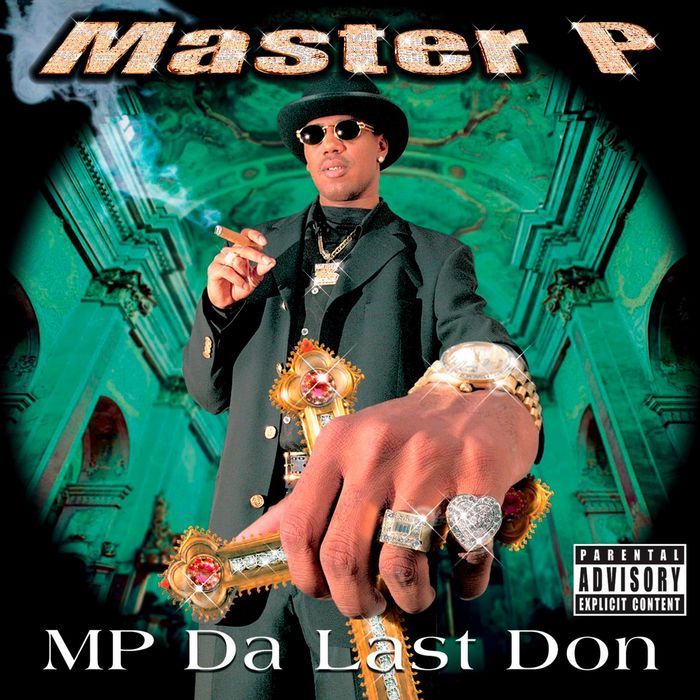
That was until Master P founded NO LIMIT RECORDS. Master P got a few thousand dollars from a life insurance policy when his father passed away. He bought record equipment with the money and used the business skill he acquired in college to launch a label. He found the best rappers in New Orleans and ended up taking the country by storm. He began getting popular when I was a freshman in high school. I now own a box set of NO LIMIT’s Greatest Hits. All of the songs bring back so many memories.

As an adult, I can see what attracted me to Southern Hip-Hop. Being a six foot and 250 pounds, I often had to reassure people I was not dangerous. A large white kid is not looked at in the same way as a large black kid. When you meet people, you can see the fear in them. I am also naturally loud, so that added to the unwanted perception of intimidation. So I always had to go out of my way to seem cheerful and happy. People often compliment me on my happy demeanor, but it is a defense mechanism to some extent.

Another stereotype I was trying to fight was the perception of hypersexuality. Being a black man people assume you are hypersexual and you could be sexually aggressive toward women. Many were particularly afraid that I could be aggressive toward white women. This fear is never verbally expressed, but you see white men treat you more aggressively if they see their daughter laugh at your joke. It is always an unspoken thing, but a man can tell if another man feels threatened. The fear of losing a woman to a black man is the source of racism for many white men. Again this is something rarely talked about, but most people know it is true.

So as a teenager with raging hormones trying to downplay his masculinity, it makes perfect sense that I needed to live vicariously through hyper-masculine rappers. One of the ways I could express my masculinity was through blasting Master P out of my 1983 Honda Accord. I could not yell my real sexual intentions out in the middle of town, but Mystikal could. These rappers said what I could not say. As an adult, I thank them for this.

I especially liked that Master P found a way to build a business and make money outside of the corporate system. Stories of black people getting used by labels plague the history of black music. Now we had our own, SOUTHERN, label with someone that shares the profit with the artist. Most NO LIMIT artist still live comfortably off the money they made in the 1990’s. Not many labels can say that about their artist.

The one act that I admired most from Master P, the act that showed me how an independent black-controlled organization could be helpful, was Master P signing Snoop Dogg. After the assassination of Tupac, Snoop feared for his life while on Death Row Records. Master P was able to buy him out of the Death Row contract and set him up in a new contract in which Snoop could keep more money from the sale of an album. Snoop’s first album on NO LIMIT Records was entitled “The Last Meal” because no one would be able to eat off his work again.

Master P is one of my biggest inspirations from my current blog site. He showed me the importance of independence and having full control over a narrative. I hope to be able to provide black people a place to speak their mind on issues involving Integral and Race Theory. So much of our movements in mainstream society are over-analyzed, and in turn, black people have to be constantly aware of other’s perception. The over-analyzing by outsiders causes black people to communicate in a stifled manner.

But getting back to Southern Pride, Southern Hip-Hop gave me Southern Pride. For the first time, I had a movement that involved me that started in the South. My parents and grandparents had the Civil Rights Movement; I had Southern Hip-Hop. I was proud of it because it was un-apologetically black. Even though I understood that the Civil Rights Movement was far more important and politically significant, I also saw its adherence to nonviolence as a realization of limited power not a display of discipline. The rappers fully asserted their sovereignty and did not care about how it came off to the outside world. Even though I knew I had to be able to portray a particular image to be able to achieve my goals, it was empowering to me to see someone else not have to do that.

Now when I told another black person that was not from the South where I was from, the conversation went to the music they liked from there. We could talk about something that my people created that was benefiting the world.

The most surprising development was my new reaction when white people started talking about Southern Pride. I no longer got triggered immediately. I now could understand how a person could find something to love about the South that eclipses all the bad. Now that doesn’t mean some white people did not use Southern Pride as a dog whistle for racism; it just means I did not assume that they were racist immediately. By holding judgment, I was able to move more easily and have pleasant conversations. Having nice conversations is better than isolating myself.

Southern Hip Hop and Hip Hop is a big piece of my identity, that is why I defend the culture against all critics. Many see Hip Hop, especially 90’s Hip Hop, as violent and misogynistic. Some of that criticism is true. However, there is so much more to Hip Hop. It gave me an identity. So when Hip Hop is attacked, I feel personally attacked. I understand that I am bigger than a genre of music, but that does not change my emotions.

That is why when Confederate monument supporters express their wish to keep statues, I can understand their perspective. As I will point out many of the positive aspects of Hip-Hop, they will talk about nostalgia for the South. Now many of the Confederate monument supporters are simply racist and using southern nostalgia as a dog whistle. However, some are not. I think a proper dialogue could create compromises amicable on both sides. I am not equating misogyny and slavery; I am just explaining how I came to understand the perspective.

White people that are ok with the statues coming down should dialogue with one that wants to keep the statues up. By dialogue, that does not mean you attempt to shame them into changing their position. There should be a mutual effort to understand. Especially, if a person considers themselves part of the Integral community, they should be able to create a healthy dialogue. As an Integralist a person should have the ability to talk to someone, not in the community and get them to think deeply about their motivations. If someone can realize why they have such an attachment, they can then understand they are bigger than a statue. The dialogue will not work for everyone. However, it could work on a few. As Integralist we have to make an effort.

If a person considers themselves part of the Integral community, then they can’t simply read books and argue philosophy on social media. There has to be a practical application of the method that involves people both inside and outside of the community. Being the second-tier means a person will risk social rejection to facilitate societal advancement. If an Integralist sees a person struggling with the removal of Confederate monuments, they will attempt to ease this suffering with compassion. If we as a community are not willing to do this, then we are no different the average American.

Bottom line is most Americans of all races, want these statues removed. They are coming down as fast as humanly possible. The question is how many violent episodes will happen during the time of removal. At this point in American progress, we should be able to make changes and improvements without violence. There was no need for Charlottesville to happen, and Integralist could stop the next Charlottesville. We got to get off the computer and get into the community and make a difference.
Background of UNLV Rebels

Many of the people in this blog work in academia in the United States. Many of these schools have Confederate mascots or Confederate statues. Here are a few examples of schools with Confederate mascots and how they handled them. I will also include my personal opinion on how they handled the situation.

University of Las Vegas Rebels

““New-Unlv-Logo-L.E.-Baskow_1_t1000””
The current mascot of the UNLV Rebels is “Hey Reb” pictured above. The UNLV’s official stance is the mascot is not connected to the Old South and has not been since the 1970’s after students protested. The UNLV website has the following quote on the name “Rebel”:

”In the 1960’s especially, it [Rebels] symbolized those who rejected convention, tradition, racism…Most of all, in southern Nevada it stood for those who had opposed northern domination in the state legislature and unwanted dependency upon Reno”

““beauregard-D65010_9_12A””

The original mascot of the UNLV was the wolf Beauregard clad in a Confederate uniform. Originally, UNLV was called Nevada Southern. The reason the school chose a Confederate mascot was Nevada Southern started as a branch the University of Nevada Reno. Nevada Southern had to declare independence from UNR. They saw themselves as modern day rebels and chose a Confederate motif for their school. To contrast the UNR Wolf Pack, Nevada chose the cartoon wolf in Confederate uniform winking and smirking. The UNLV official website contends that the mascot was not meant to offend, but be a playful jab at the larger school.

The Confederate motif did not stop at sports. The Nevada Southern student government called itself “The Confederate Students of Nevada Southern.” The largest school social event was the “Confederate Cotillion, ” and the school paper was called “Rebel Yell.”

Students began to protest the Confederate motif in the 1970’s. Student athletes that refused to wear the wolf logo led the protests. The students were allowed to vote on the wolf logo and the name “Rebel”in 1971. The students chose to get rid of the wolf but keep the name rebel. The wolf was officially dropped in 1975. In the 1970’s, the school transitioned between the UNLV Sun logo and a colonial soldier logo both pictured below.

In 1983 UNLV, transitioned to its modern day trailblazer. The original logo is below. After a few years, the mascot was named “Hey Reb!”. Over the years the logo has changed, but it always had a gray hat and long mustache.

Many people have been protested recently against “Hey Reb!”. In 2015 two hundred students protested the name. The Charleston killings sparked the protest. Senator Harry Reid also encouraged UNLV to change the name. There was even an internet campaign to replace “Hey Reb!” with Admiral Ackbar from Star Wars Rebel Alliance.

To UNLV’s credit, it is one of the most diverse campuses. A 2015 LA Times article claims it has around 50% minority enrollment. According to the same article all but one member of the undergraduate Black Student Organization supported the mascot. Most of the minorities polled in a recent survey admitted the mascot looked like a Confederate Soldier.

Historically the UNLV was not segregated, and a 1962 Rebel Yell article condemned the University of Mississippi for not integrating. Bill Casey, a black man, played quarterback for the UNLV rebel in 1968. The 1968 team also had the Confederate battle flag on the helmet. Casey said he did not experience any racism on that team.

Nevada’s Civil War and Civil Rights History

Nevada entered the Union in 1864. Of course, it supported the North which was the only way it could gain entry. Lincoln waved the population requirement to ensure there would be enough congressional votes to pass the thirteenth amendment.

Many of Nevada’s original settlers were from the South. There was always fear that Southern sympathizers would try to overthrow Union installation. The Knights of the Golden Circle, a later faction of the KKK, were very active in the area. However, a strong Union troop presence squelched any serious resistance. The part of Nevada that holds Las Vegas was part of Arizona at the time. The Arizona Territory sided with the Confederacy in the Civil War.

Las Vegas has a fraught racial history, and Nevada earned the name “Mississippi of the West.” A 1954 Ebony magazine article claimed the segregation there was as bad as any place in the Deep South. All black people had to stay in the slum of West Las Vegas. There is even a story of a black woman being sent to jail simply because there was nowhere else for her to stay. There were reform efforts but those that supported gambling fought against black people. However, blacks continued to fight and desegregated Casinos in the Moulin Rouge Agreement in 1960.

Justification of the name “Rebels”

Another justification is that the basketball team is known colloquially as the “Runnin’ Rebels.” In the 1980’s the team was dominant in their division, and they were known nationwide as “Runnin’ Rebels.” To change the name would break the basketball history. Also, another name would not have the alliteration and ring.

Personal opinion on if the Mascot should change

The UNLV mascot should be changed to something that can’t be mistaken for Confederate. Even though the official school statement says the mascot is a pathfinder, depictions of his head with only a gray hat would lead a person to believe the mascot is a Confederate soldier. A change as simple as changing the hat to the other school color of crimson and the name to HeyJeb! would be enough to stop any confusion.

Nevada has no official Confederate history. Nevada was part of the Union in the war. The Southern sympathizers in the state were jailed or executed. There is no one from the state they are honoring with the name Rebels.

Given the stereotype or perception that Las Vegas is a racist place, the University must work diligently to fight this misconception. Ultimately, qualified candidates from all minority backgrounds will be turned off by the mascot. It would also make more sense and be more historically accurate to honor the Union troops that fought in the Civil War or some other aspect of Nevada history everyone could celebrate. Ultimately, UNLV and the state of Nevada is bigger than a mascot.

By claiming the mascot is not a Confederate, with the name HeyReb and a gray hat, they are doing the minorities at the school the worst disservice. Some of the most severe psychological trauma happens a person is told what he sees, thinks, and feels is not real. To say that the people that created that mascot did not have it planned the entire time to portray him as a Confederate is silly. The creators of the mascot knew full well that if the mascot only had the hat, he could be seen as a Confederate. It doesn’t matter if the depiction of the entire mascot has him in a red, western-style coat. Most depictions have the mascot in a gray hat with the word Rebel underneath. The insult to black people’s intelligence is doubled when supporters act like the mascot and symbols could not easily be changed.

If the mascot does not change, school officials should expect black and minority students to not support the team unless they are playing and not buy merchandise. I have heard many times in my life that black students have less school pride or patriotism. Situations like the UNLV Rebels, makes black people feel disenfranchised. Once a person feels disenfranchised, they will act out or isolate themselves.

Return to Series

Sources
UNLV Rebels

  • Why are the UNLV sports teams represented by a Confederate rebel https://lasvegassun.com
  • Hey Reb! And “Rebels Nickname https://www.unlv.edu
  • At UNLV, A North-South divide over Rebel Mascot by N.Duara http://www.latimes.com
  • A brief history of our mascot http://www.unlvfreepress.com
  • The Curious Case of UNLV’s Not Racist Mascot http://www.deadspin.com
  • “Justice is Slow but Sure” by Q. Taylor Nevada Law Journal
  • Has UNLV distanced itself enough from Confederate past? http://www.lasvegassun.com
  • UNLV President says Rebel nickname and mascot should stay by I. Whitaker http://www.lasvegassun.com
  • Why are the UNLV Sports Teams represented by a Confederate mascot http://www.lasvegassun.com
  • What’s in a name: UNLV report on Rebel nickname yields interesting tidbits by I. Whitaker http://www.lasvegassun.com
  • UNLV Rebel Mascot Report Nov 2015 by Rainer Spencer Ph.D.
  • Nevada http://www.nps.gov
  • How the Confederacy claimed Southern Nevada during the Civil War http://www.reviewjournal.com
  • ”Mississippi of the West” in 1954 Magazine’s scathing article turned heads in Las Vegas http://www.lasvegassun.com
  • Civil Rights Act http://www.knpr.com
  • Bert Babero

    Bert Babero led protest to remove the Confederate Wolf Beauregard at UNLV. He recounts the story in this interview. He also talks about his life after college and his views on politics.

    Background on UNLV Mascot

    Interview with Bert Babero

    Website Powered by WordPress.com.

    Up ↑