Search

Black Leadership Analysis

This is an unofficial Spiral Dynamics blog. It is not endorsed by D. Beck PhD.

Tag

Dalit

Who Were The Untouchables

In this treatise, Ambedkar attempts to explain the origins of untouchability. He admits there is no conclusive evidence of the birth of untouchability. However, he presents a theory that is supported by more evidence than other arguments at the time. He admits this is not a final thesis on untouchability and the subject will need more research. He also debunks theories of a popular analyst Stanley Rice.

He starts off by addressing the fact the Brahmins that normally study the subject would do little to debunk or undermine the basis of the caste system. The caste system gives them privilege. To quote Ambedkar:

It must be recognized that the selfish interest of a person or of the class to which he belongs always acts as an internal limitation which regulates the direction of his intellect.

Ambedkar begins by analyzing practices of untouchability outside of the Hindu culture. He uses examples from primitive and ancient times from all over the world. In all the cases outside of India, untouchability is:

  1. Caused by and action or bodily change such as puberty or pregnancy
  2. The untouchability was lifted after proper ceremony or time had passed
  3. After purification the person could return to normal life

Only in India is untouchability something someone is born into and there is no way to get out of it. Untouchability doesn’t relegate someone to lowly and unsanitary occupations as it does in India. The untouchability faced by the Dalit is unique in India.

A unique feature of Indian untouchability is that untouchables have to live in ghettos outside the city. The condition of Dalits residing in ghettos is prevalent in India and often mandated by law. Ambedkar postulates that Dalit lived on the outskirts from the beginning and their presence there has nothing to do with untouchability.

In primitive society, there were people in settle tribes and nomadic herdsmen. In ancient India, the primary source of wealth was cattle. The nomadic herdsman would follow there cattle herds along a migratory grazing path. Those that settled were able to have livestock and produce. The nomadic herdsman would raid the settled village tribesman because they had more food on average. Ancient India was in a constant state of war.

Ambedkar then postulates that those that broke ties with their original tribe would be left alone to fend for themselves. They would go to a settled tribe and live outside the village and act as watch and ward. In the event of an attack, these men would be on the front line. Ambedkar calls these ex-tribesman Broken Men.

To support his theory, Ambedkar shows a similar situation happened in Europe. In ancient Ireland and Wales, Broken Men served as watch and ward over settled estates. Those orphaned by their original people could live outside of the village. However, in Ireland and Wales, these people eventually integrated into society due to intermarriage. Untouchability prevented this from happening in India.

Even though there is no direct evidence, Ambedkar postulates that the Broken Men came to adopt Buddhism. As Buddhists, they did not see the Brahmin as superior or respect their exclusive right to religious ceremony. Hindus began to bar Buddhism from their temples, and Buddhism repaid the favor causing conflict in the communities. The tension is well documented in Hindu literature even though there is no direct connection between untouchability and Buddhism. Also when Hinduism won most of the inhabitants of India, there were those that would not let go of the Buddhist faith. The Hindus shunned the Broken men because of their religion and imposed social segregation.

Another possibility is that the Broken Men never observed the custom of making the cow sacred. All untouchable communities eat beef or make products out of cow skin. The consumption of cows was viewed as disgusting by Hindus. Beef eating caused untouchability, the act of declaring a group impure in perpetuity.

Now beef eating was not always prohibited. Early Hindu scriptures written by Manu do not ban beef eating. The prohibition came as a strategic way to win public support from Buddhist. Buddhism prohibited animal sacrifices and Hinduism did not. The public began to see the practice as wasteful and cruel. To improve Hinduism’s stance with the public, the Brahmin chose to be vegetarian and forbid their followers from eating beef. Brahmin dietary laws gave us the present classes of Brahmin, Non-Brahmin caste Hindus, and Untouchables. The earliest Hindu prohibitions on beef eating came in the 400’s AD.

The question remains as to why did the Broken Men not stop eating beef. It is possible that the Broken Men only ate cows that were already dead. Since the law was against killing a cow, the Broken Men did not violate the law. To give up beef would mean starvation. Because Dalit only had lowly professions buying other food was not feasible. Those that ate the flesh of the cow for any reason became hated once the Hindu exalted the cow.

Many Hindus believe scriptures mention untouchables and untouchability. There is one word “Asprashya” used three times in Hindu scripture that means “untouchable.” However, there is no detail in these scriptures to know why the people were untouchable or what were the rules of untouchability. Ambedkar explains that many of the other words loosely translated into “untouchable” are explaining a temporary state of impurity or merely living on the outskirts of town. The birth of untouchability came with the bans on killing cows implemented by the Gupta kings around 400 AD.

Debunking Dr. Stanley Rice

Dr. Rice postulated that the Dalit were the aboriginal race of India and that the Dravidians invaded and conquered them. After that, the Aryans from Central Asia conquered the Dravidians. Ambedkar used the same evidence as he did in Who are the Shudras to show that the names of people groups in the Hindu scripture denote people of different faiths, not races.

Further evidence that caste does not denote different races or levels of miscegenation also comes from science. Studies on the facial features show people of the same province and different castes have more similar characteristics than the reverse. Also, a survey of last names shows that lasts names are more common in regions than in castes. The commonality of last names in regions and not castes show intermarriage and intermixing happens even when the practices are strictly prohibited by law.

One piece of evidence discussed in Who are the Untouchables not discussed in Who are the Shudras was the Nagas people. Stanley postulates they were the aboriginals and Ambedkar shows they were people that worship a snake god. The Vedic term Dasa and Naga refer to the same people. Dasa denotes peoples using their king; Naga denotes the people using their god. The Naga people and their religion were pervasive throughout India, Sri Lanka, and Central Asia.

Dr. Rice also postulates that untouchability came about because of the need to segregate people doing unsanitary jobs before proper cleaning technologies existed. Ambedkar points to Hindu scriptures that show upper caste people doing unsanitary jobs and rules for them to do unsanitary jobs. Therefore there was a time when anyone could do an unsanitary job.

Notes on Manusmriti

Ambedkar mentions that a revolution happened in which Hindu kings overthrew and killed Buddhist kings. The Brahmin participated in this revolution. Their old scripture prohibited Brahmin from touching a weapon. They also considered the body of any king sacred, and regicide a sin. Manusmriti was created to change these rules to allow Brahmin to fight in the revolution.

The centrality of Manusmriti in the conflict between Buddhism and Hinduism could be a reason Ambedkar chose to burn this book publically December 25, 1927.

A copy of the full-text can be found HERE

The Untouchables and the Pax Britannica

This treatise was used as evidence in the Round Table Conference. It explains the unique suffering of the Dalits and how Britain was coupable.

He begins with a short history of how exploration centered around finding routes to India. The conquest of India was unique in that it had a complex government when it was conquered that had survived for hundreds of years. Another aspect of the conquest that is perplexing is how the East India Company was able to capture the area without help from those in Britain. The Napoleonic Wars were raging from 1757 to 1818, and they consumed most of Britain’s resources. Ambedkar’s answer the East India Company employed Dalits as soldiers. Four of every five East India Company soldiers was from the native Dalit population.

Dalits made a name for themselves in the military and did more than enough to prove they were a martial race. They were instrumental in the suppression of The Mutiny of 1857. Unfortunately, as British influence spread to the upper caste, Dalits were unceremoniously banned from military service. The ban began in 1890, and in twenty years most of the Dalit in the military retired. The only exception was a brief lift on the ban during World War 1.

Other avenues of advancement were not available to the Dalits. The Civil Service requires education, most commonly it requires a college degree. Even when Dalit obtain degrees, the Caste Hindus in charge of the department will not hire them out of prejudice. Not only would prejudice prevent Dalit from being employed, but the tradition of untouchability would also prohibit them from working. For example, if a Dalit were to arrest a Caste Hindu, he would have to enter his home. The act of entering the house of a Caste Hindu would make the home unclean. Therefore Dalits could not be policemen.

Britain excluded Dalits from education in 1854. The lift on the ban to Dalit education came with no effort to integrate the schools. Therefore those in charge of the school would find ways to exclude Dalit. The only education available to Dalit’s was from the Christian missions. After 1882 Britain created special schools for Dalits. They also gave grants to missions that educated Dalits. However, these efforts were not enough to significantly raise the level of Dalit education.

Ambedkar contrasts education levels among Dalit to education levels among Muslims. Muslims were also a disadvantaged class, but their education was second only to high Caste Hindus. The reason is Muslim petitioned for reserved representation in school administration. These administrators were able to earmark funds and resource to combat specific education hurdles in their community. If Dalit had been given the same representation, their fate might have been different.

Britian has made laws in the past that go against local customs to keep order and observe human rights. A short list can be found below:

  1. A law preventing BRahmin from killing women and children
  2. Removal of restrictions on the marriage of widows
  3. Prohibition of using religious law in arbitrations between Hindu’s and Muslims
  4. Law against rape
  5. Law against marriage of women under ten years old

These laws have helped India to modernize. However, Britain has not banned untouchability or the observation of caste. Early on Britain did not see anything wrong with the practice as they practiced similar customs in their African and American holdings. Later on, they felt advocating for Dalits would cause turmoil. Ambedkar reiterates there is more than enough court precedence to justify laws against caste and untouchability. Not only is protecting Dalits morally right, but Dalits are also currently paying taxes for public service they can not use, such as wells.

A copy of the treatise can be found HERE

Which is Worse?

In this treatise, Ambedkar compares slavery to untouchability to see which one is worse. Slavery is broadly defined and the condition in which one person is the property of another. He offers two more detailed definitions of slavery.

Detailed Definition of Slavery 1

A person suffering from all three of the following conditions.

  1. A person can be sold, mortgaged, or leased
  2. A person can be killed with no repercussions
  3. Condition prescribed by law

Detailed Definition of Slavery 2

A person that is viewed as not having the capacity to acquire rights and bear duties. Rights are defined as:

  1. Right to unmolested pursuit of the occupation by which man chooses his livelihood
  2. Right to transport and free travel
  3. Right to protection from fraud
  4. Right to have the family one wants

Untouchables are not slaves by the first definition. Untouchables are not slaves by the second definition either. The law does recognize an untouchables rights to the four rights listed. However, the untouchable does not have these rights within society. The general population does not recognize the untouchables capacity for rights.

Ambedkar uses examples of how Rome and the USA gave slaves some ability to acquire unique skills. In both cultures, a slave with a skilled trade or profession would be sold and leased at a higher rate. He gives examples of Roman slaves that could quote Homer, and American slaves that were trained as doctors.

Also, a master had financial incentive to protect a slave. In Rome slaves never worked in areas infested with malaria. The wealthy slave owners would not damage their property. Frequently freedmen worked in locations inflicted with malaria.

The condition of the Jews in Europe was briefly discussed in this treatise. The Jews suffered many of the same indignities as an untouchable. However, a Jew could convert to Christianity and have legal protection. Jews chose solidarity in spite of oppression. Therefore their condition is better than the untouchables.

He also briefly mentions the British ended slavery in India in 1843.

A link to the original document can be found HERE

Essay on the Untouchables : Dalit and Christianity

Ambedkar begins the treatise by justifying the need for a mass conversion of Dalit. Most Dalits have determined Hinduism will never be conducive to Dalit uplift. Ambedkar then purposes a reasoned and logical evaluation of all religions to see which religion will suit the Dalit’s unique needs.

Many critics would characterize this type of evaluation as artificial and solely politically motivated. Ambedkar retorts the criticism by showing that most Christian conversion in the middle ages came after the king of a country was converted. The subjects would convert in mass to follow the king. If the subjects did not, they would be politically isolated.

Religion is by its nature communal. It projects the essential values of a community on to the universe. The purpose is to unite a community of people beyond extended family bonds. In primitive society, extended family bonds determined those that hold your life sacred and those that do not. Religion binds people beyond the family and creates a means of social control. Law and police can’t contain a society if the people don’t fundamentally respect life and property.

The concerns that a new Dalit religion needs to address are the Dalit’s social isolation and the resulting inferiority complex. To end the social isolation Dalit must move to a group that does not recognize caste. Hinduism will never serve this purpose because caste is a fundamental part of the Hindu religion. Ambedkar even goes further saying that a Dalit that accepts Hinduism accepts her oppression. Also, there is no altruistic center in Hinduism. All forms of behavior can be accommodated under certain pretenses.

A brief history of Christianity in India is given before arguments for and against it are presented. The first missionaries came to India from the Syrian church 800 years prior. They were followed 400 years later by European Christians. Many denominations of the church have created extensive charity networks in India. The goal of the charity networks is to build an audience to listen to gospel. However, there has been no effort to make the society of India more equitable, thus relieving the need for charity.

There were three main impediments to the spread of Christianity in India. One, early European Christians that settled in India were unruly sailors. Two, infighting between various denominations of the Christian church distracted from evangelizing. Three, the church adopted a failed strategy of concentrating on Brahmin converts assuming lower castes would automatically follow. The loss of privilege disincentivized Brahmin conversion. At the time of publication, there were only 6 million Christians in the subcontinent housing 358 million people. Most of the Christians were Dalit and most incorporated Christianity in their Hinduism instead of making a full conversion.

Christianity could not fundamentally challenge Dalit’s social isolation. Christianity itself was a composite community of different denominations. Also, the church kept the caste system going in its India churches. Different castes have different churches. There was no effort to change because a version of caste is practiced elsewhere in Christendom. In America and the Caribbean, blacks are separated from whites. In Europe, people of high class are separated from people of low class.

Christian believe the fall of Adam caused inequality. Therefore nothing can be fundamentally done to make life more equitable. The belief in predetermined inequality due to “The Fall” is no better than believing the cause of inequality is past karma. They also assert once a person accepts the religion they will be forgiven of all sin. The belief in absolute forgiveness also disincentivizes the need for social reform. Dalit can’t join a religion that does not facilitate their active striving for social justice.

Gandhi was briefly discussed in the treatise. Ambedkar shows that he vehemently fights against the conversion of Dalit to Christianity, but will not do the same to stop Dalit conversion to Islam. The discrepancy in Gandhi reaction was political according to Ambedkar.

Gandhi is quoted in this essay as saying ”They (Dali) can no more distinguish between the relative merits… than can a cow. (Dalit) have no mind, no intelligence, no sense of the difference between G-d and no G-d”. This statement shows Gandhi’s feelings for Dalits and his belief in Brahmin superiority.

The full essay can be read HERE

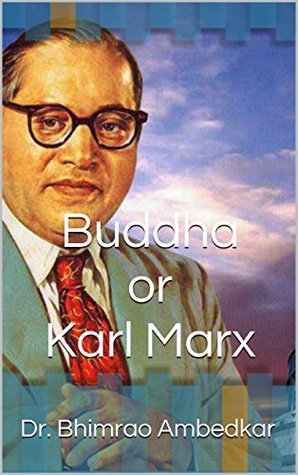
Buddha or Karl Marx

Buddha or Karl Marx

34 pages

Dr. Ambedkar admits that at first glance a comparison of Buddha and Karl Marx seems unreasonable. However, both can be considered practical philosophers attempting to create a more equitable world. Also, both saw that the abolition of private property would lead to a fairer and freer society.

Karl Marx proposed what he felt was a scientific socialism. In Marx’s estimation, a revolution by the poor was inevitable due to mounting inequality. The poor would collectively own the means of production through dictatorship. Once the dictatorship removed the concept of private property, a new equitable society would flourish.

However, the Communist plan has been implemented in Russia since 1917 after a violent revolution. The implementation of policies has also necessitated the use of violence and coercion. The use of force has no end in sight. Even though Marx claimed that implementing Communism would eventually lead the dissolution of the state, there is no evidence of this happening. Also if the state dissolved, it seems it would be replaced by Anarchy.

In contrast, Buddha set out to change people’s understanding of the world. Ambedkar then goes on to explain various Buddhist concepts such as The Four Noble Truths, The Ten Hindrances, and the Ten Virtues. He describes how these teaching systematically remove the idea that the individual can exist on his own or personal gain will lead to lasting happiness (ego). Once a person thinks in a collective sense, they will not want to own the means of production and want it owned by the collective.

To reframe this in Integral terminology, Buddha focused on interiors, and Marx concentrated on exteriors. Buddha understood that external changes only happen once a person’s attitude changes. If externals change without the internals, there will always need to be some greater force holding society together. People will not be motivated to maintain a healthy society without coercion so the society will always be unstable.

One of the criticisms that Communist often levy on Buddhist or people with religion is that religion makes people “otherworldly”. Those with religion care more about the afterlife than building an equitable future here on earth. Ambedkar illustrates how Buddhism professes and supports building material wealth inside the boundaries of law and morality. Buddhism is not an otherworldly religion. Ambedkar goes further to say Communist attempt to paint all religions with the same brush.

The read the entire book yourself click on the link below for a PDF copy.

Buddha or Karl Marx

Manu and the Shudra

In this treatise, he gives some background and explanation of Manusmriti, the book that codified caste law. He explains many of the rules that affected Dalits and other lower caste people.

According to Manu, the person/demigod that codified rules of Untouchability, the world is composed of those inside the caste system and those outside the caste system. Of those inside the caste system, there are priests (Brahmin), soldiers (Kshatriyas), vendors/traders(Vaishyas), and servants (Shudras). These castes were listed in descending order.

The book goes into detail on various ways in which Dalits were marked and insulted.

  1. Had to leave town from 3 pm to 9 pm to not cast a shadow on higher caste
  2. Had to hang a pot around his neck to catch spittle
  3. Had to wear black necklace, black wristband, carry broom to sweep away footsteps, or wear horn
  4. Had to wear old or torn clothes
  5. Can’t build more than a one story house
  6. Not allowed to cremate their dead

One interesting point in the book was his thoughts on Shudra forming their political party and electing the best candidate that was Shudra. Ambedkar says that the action of selecting someone just because they are Shudra is no better than choosing someone just because they are Brahmin. The Shudra are attempting to dominate in the same way as the Brahmin

Ambedkar never published or completed this work.

Found in the book The Selected Works of Dr. B.R. Ambedkar found online for free.

The Origins of Caste (Caste in India)

The Origins of Caste is an early work of Ambedkar written in 1916. The treatise gives a preliminary explanation of the origin and propagation of caste. It also critiques the interpretation of castes provided by others. In the end, he reiterates this theory is preliminary and could require more research.

He summaries the root caste from others to begin. The other theorists say the caste system is rooted in myths of lineage, traditional occupation, or ceremonial purity. Ambedkar describes all the opposing theories as partially correct. However, he makes his case for the root of the caste system being the prohibition of intermarriage between castes.

When a person understands the root of the caste system is the prohibition on intermarriage, many other customs can be easily explained. The prohibition on intermarriage, each group, must ensure there is an equal number of males and females. If a spouse dies, then there is a surplus man or surplus woman. This adult with no sexual partner would have the incentive to look for a mate from outside the caste. To prevent the widow from a cross-caste marriage, she can be thrown on the funeral pyre or take a vow of celibacy. For a widower, he can be forced into celibacy or given an underage girl to wed.

He criticized that the rule of caste was set forth by one authoritarian ruler, Manu. It would be difficult for one man to enforce these laws during his reign against the will of the people. It would be even more challenging to create a lineage of rulers that did the same thing. It is also unlikely the Brahmin forced caste rules on the lower caste for the same reason.

Ambedkar theorized that the most likely explanation is the Brahmin decided to close themselves off by forming a caste. The next highest social class then converted themselves into a caste to improve their social standing. This behavior continued until finally those at the bottom of society were completely shut out. To support the claim Ambedkar calls to the attention of the reader; there are fewer purity rules the further a person’s caste is from the Brahmin.

The treatise is crucial because it provides a basis for Ambedkar’s struggle for the rights of women with the overall social justice struggle. As women win the right to marry and love as they wish, the foundations of caste will be destroyed.

A copy of this treatise can be found on Google Play or from the below link from Columbia University.

http://www.columbia.edu/itc/mealac/pritchett/00ambedkar/txt_ambedkar_castes.html

Who were the Shudras?

In this treatise from 1946, Ambedkar focuses on the origin of the Shudra (Menial) class. It studies Vedic scripture to get a clear picture of the origin of the castes system. The treatise also refutes the Aryan invasion theory, that is popular today and in the time of Ambedkar.

Some background on the caste system will be needed. The caste system is a social structure in which people are segregated into groups that are typically associated with professions. People can’t marry outside of caste or get an occupation that is reserved for another caste. Certain types of contact from lower caste can cause the higher class to need cleansing. A ceremony conducted by a Brahmin (priest) can fill the cleansing requirement. There are four Hindu castes: Brahmin ( priest), Kshatriya (soldiers), Vaishyas (traders), Shudras (menials). The Dalit (untouchables) are considered to be a caste by some. However, most Dalits feel that they are outside Hinduism. Dalit are not covered in this treatise.

The prevailing theory of the origin of caste in 1940 was the Brahmin descended from a central Asian tribe called the Aryans. The Aryans conquered the native Dravidian people. The Brahmin are those with the purest Aryan blood, and the lower castes are mixed until finally, the lowest class was pure Dravidian. Aryans had a white skin complexion and Dravidians had a dark-skinned complexion. This idea of mixing of race degrading a people was used to segregate people all over the world. It also was also used to justify white rule in India and other places.

He begins by laying out his main premise.

  1. The Shudra were an Aryan community
  2. There was a time only three castes were represented Brahmin, Kshatriyas, and Vaishyas
  3. Shudra were Aryans and part of the Kshatriyas (soldier class)
  4. The Shudra began a feud with the Brahmin on the exclusive rights to religious ceremony
  5. In retaliation, Brahmin refused to perform Upanayana on Shudra, Upanayana are the rights that are a prerequisite to land ownership and education
  6. The prohibition on Shudras from owning land or being educated led to the degradation of the Shudra.

The Shudra were an Aryan community

The word “Aryan/Aryas” was never used to mean race in the Vedic text. It derives from a Sanskrit word that meant plowed land. The term was used to differentiate the Aryan people from less sophisticated scavenger and nomadic tribes. After Vedic times Aryan meant nobleman or respected person. The only physical description of the Aryan people describes them as long-headed. Long-headed people could have any skin color.

Not only do the Vedic text not imply that Aryans have white skin. Many of the main characters in the Vedas that are Aryan are said to have a dark complexion. Rama, Krishna, and Rishi Dirghatamas all are said to have had dark skin. It is most likely that Aryans were white, copper, and black in complexion.

Also, the Vedas say that Dravidians/Dasus would convert and become Aryans. That leads Ambedkar to believe Aryan and Dravidians are early cults of Hinduism. Individuals could experience Aryan culture and determine they wanted to switch. The ability to change Varna would not be possible if Aryan denoted race. Also, the word “Varnas” which is normally translated as color, actually derives from the Sanskrit word for faith.

There was a time only three castes were in Hinduism

References to the four castes are found in the Purusha Sukta, which Ambedkar proves is a late addition to the main text of the Rig Veda. Therefore, there was a time only three castes existed: Brahmin, Kshatriyas, and Vaishyas. These three are the only ones mentioned in the Rig Veda main text.

Shudras were Aryans part of the Kahatriya (soldier) caste

The Shudras are the mythic progeny of the Vedic character Sudas. Sudas was a king in ancient India. Sudas coronation was conducted by Brahmin, a sign that he was Kshatriyas. Sudas was also said to be wealthy and respected before the skirmish.

The Shudra fought the Brahmin for the right to perform religious services.

Ambedkar uses passages of the conflict between Vasishtha and Vishvamitra as an allegory about the conflict between Brahmin and Kshatriya’s priest. Both were performing religious rights. Vishvamitra was a Kshatriya and wrote some of the Rig Veda’s hymns. Vasishtha was Sudas chief priest. Sudas fires Vasishtha and hires Vishvamitra. Also, Vasishtha’s son is killed by Sudas. Vasishtha’s son questioned Vishvamitra on an important matter. To hold Vishvamitra’s honor, Suda’s murdered the young lad. The sons and all the progeny of the two sides continued the feud. The Purusha Sukta and the Manusmirti hold the information on this conflict.

In retaliation, Brahmin refused to perform Upanayana on Shudra, Upanayana are the rights that are a prerequisite to land ownership and education

To retaliate on the Kshatriya’s priest, the Brahmin refused to perform Upanayana on the Shudras. Upanayana was an initiation rite that allowed a person to be educated and own land. Conducting sacrifice according to the Vedas was the primary reason for property ownership. The Vedas also say the Shudra of that time were few. The Brahmin held power to perform Upanayana and deny it to anyone for any reason.

The prohibition on Shudras from owning land or being educated led to the degradation of the Shudra.

Because the Shudra did not have education or land, they could not do anything other than menial tasks. They were not genetically deficient or fated to live in a servile state. The denial of Upanayana to women caused the same situation.

Also, the modern day Shudra are not descendants of the mythic Sudas. Shudra came to mean “low-class” or uneducated person. All those not Dalit or upper class got the epithet. If people understood the modern Shudra were not the descendants of Sudas, violence against them would stop.

Ambedkar also debunks the Aryan invasion theory. The Vedas have no record of an invasion. If the Aryans were conquerors, they would boast about their conquest. Both Aryans and Dravidians were native to India and are not related to Europeans. The Aryan Invasion theory was started by Europeans to justify conquest and accepted by upper-caste Indians to justify caste rule.

Why is “Who are the Shudra” important”

Who are the Shudra shows how important it is to study something through many cultural lenses. Had Europeans and upper-caste Indians been the only ones looking into the subject, many biases would not have been uncovered.

Also, the roots cause of disparity between groups is the denial of education and land. Systematic economic disenfranchisement is true in Indian history, African history, and American history. There is no situation in which a people with full access to education and property over the entire history of a country ends up in a servile position.

The full-text can be found HERE

Website Powered by WordPress.com.

Up ↑