Search

Black Leadership Analysis

This is an unofficial Spiral Dynamics blog. It is not endorsed by D. Beck PhD.

Month

May 2019

What Happened to Black Bookstores?

Often you will hear black people say; blacks don’t support black business because we are brainwashed. We think the white man’s water is wetter and ice is colder. In actuality, black business suffers from some unique external problems and the same market forces that cause other companies to fall. This post will look at the history of black-owned bookstores and why we see so few black-owned bookstores now.

The first surge in black bookstores happened from 1965 to 1979 with the number of black bookstores increasing from twelve to around one hundred. The black book boom did not occur in a vacuum. The innovation of soft cover books in 1930 made books cheap enough for the masses. The number of printed books doubled from 1952 to 1962 and sales went up 83% from 1963 to 1971. So more books were available at a lower price to a market of black people who saw their income rise 140% from 1947 to 1960. Black bookstores were the outer manifestation of a book craze that took over the country.

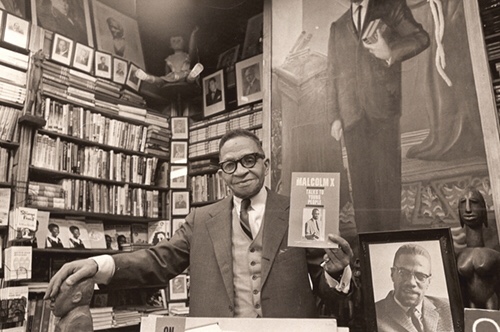
One of the first black-owned bookstores was Lewis Michaux’s National Memorial African Bookstore started in 1939. The bookstore was not only a business but an epicenter of black politics in Harlem. Many other book entrepreneurs will duplicate this activist business model. The National Memorial Bookstore would host Nation of Islam rallies and book signings by Nikki Giovanni.

Michaux’s main competitor in Harlem was Una Mulzac’s Liberation Bookstore. Mulzac got into the book business while working with Leninist in British Guiana. When a new regime took over in that country, her store was closed, and she was deported back to America, the place of her birth. Her bookstore began in 1967.

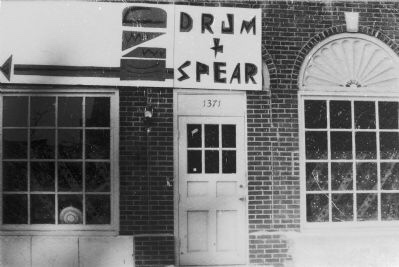
Washington, DC had its own activist bookseller Charles Cobb Jr. In the wake of the Dr. King riots in 1968, Cobb opened up Drum and Spear with a grant from the Episcopal Church. Over the years, Mr. Cobb developed a mail-order catalog, publisher, and wholesale operation. Drum and Spear became the largest black bookseller by 1971.

One of the key drivers of the first black book boom was the Civil Rights Movement. As black people began to assert themselves, racist forces also worked to thwart them. FBI documents released through the freedom of information act revealed there was a concerted effort from 1968 to 1973 to monitor the activities of these bookstores. The FBI believed the owners were connected to communist and black nationalist groups committed to overthrowing the American government.

There was no store hit harder than Edward Vaughn’s Vaughn Books in Detroit. Mr. Vaughn was traveling to New Jersey when a race riot broke out in Detroit in 1967. He rushed back to his city to ensure his store was not damaged. On the way home, he is detained in two different states for questioning. Upon his return to Vaughn Books, he sees the words ” Long Live the African Revolution” graffitied on the door.

Mr. Vaughn sees the first order of business as trying to improve race relations in Detroit. He sends a telegram asking to meet with city leaders to discuss solutions. The mayor’s office gives no response. In later weeks the Detroit PD firebombed the store, but Vaughn repaired the damage. The police made a second attempt to destroy the store. They broke in clogged a pipe and turned on the faucet flooding the store. Vaughn again rebuilt and repaired the damage.

Drum and Spear was only blocks away from FBI headquarters, so they were visited frequently. Mr. Cobb was heavily involved with the Student Non-violent Coordinating Committee in Mississippi and often recognized agents. One FBI agent admitted after months of surveillance, he realized that Drum and Spear was no different than any other bookstore. The FBI officials don’t believe him and demanded the agent find proof that the store was involved in communism. The agent bought a copy of Mao’s Red Book from a white bookstore and claimed he got the book from Mr. Cobb to satisfy his superiors.

The core patrons of Drum and Spear solidified around his business after they realized the FBI was attempting to destroy him. A similar phenomenon happened with Vaughn books. However, Cointelpro put too much pressure on the black power movement to keep it viable. The movement as a whole started to falter and wain. Black Nationalist started to leave the movement because involvement necessitated people taking a high risk with little material reward. Many black activists found steady work; others worked for change in multi-cultural movements.

In addition to the black power movement losing steam in the 1970s, Black Americans began to experience an economic downturn. Three years after being proclaimed the largest black bookseller Drum and Spear closed in 1974. Black America was more interested in individual success and not attempting to work for systematic change.

In response to the general change in Black America, a new genre of black books emerged, the black romance novel. The first installment was Entwined Destinies in 1980, followed by Adam and Eva. These books pushed no political ideology. Instead, they concentrated on universal themes of love and heartbreak. The black romance genre was easy to mainstream because anyone could relate to the stories.

Terry McMillan was the largest cross-over black romance novelist. Her first book was Disappearing Acts in 1984. She marketed by catering to black bookstores. The strategy continued to her second book in 1987 Mama. However, once a mainstream audience was able to sample her work, she began to sell at white bookstores.

In the late 1980s, a new development happened in the booksellers market, the megastore. Stores such as Barnes & Nobles or Borders were able to eat up market share by having black interest sections. Also, by having a network of stores all over the country, a customer could order books that were not in stock at their local store. So the megastores offered a better product at a lower price. So small bookstores, no matter what the interest, were on the decline. In 1975, small booksellers had 60% of the market by 1997 the share had fallen to 17%.

In 1992, three black women were on the New York Times Best-sellers list. Possessing Secret by Joy Walker, Jazz by Toni Morrison, and Waiting to Exhale by Terry McMillian. This was the first time three black authors were on the best seller list at the same time. McMillian became a household name and conducted appearances all over the nation.

In 1997 durning the How Stella Got Her Groove Back tour, McMillan was set to conduct a book signing in Missouri. Antoine Coffer owner of Afrocentric Cafe protested the signing on the basis that she should do the signing at a black-owned business. Coffer called for a national boycott of McMillian unless she promised to do more book signings in black-owned bookstore. The book signing was scheduled at Library Ltd which had twenty-five times as many titles. The publisher decided to cancel the event in Missouri to avoid bad press. In reality, most of the black bookstores stayed afloat selling romance novels like Waiting to Exhale. This boycott would not only hurt one of the authors that kept Coffer’s business viable, but it would also only hurt black bookstores as a whole.

In the end, the novelty of black romance novels wained. They became just like any other romance novel in the genre. Most of the black bookstores could not compete with large sellers, and Amazon was a death nail by 2014 only 54 black-owned bookstores existed in the USA.

According to a Publisher’s Weekly article black bookstores are back on the rise. In 1999, there were 325. By 2014 there were only 54 in the USA. Fortunately, the number is back up to 108 in 2018. One of the stores Mahogany Books has a physical location in Washington DC and an online branch. Marc LaMont Hill’s bookstore is also inter-sectional offering queer studies, disability studies, and gender studies. So black bookstores are changing with the times.

Ultimately, there was a government plot to destroy black bookstores, but the larger factors were changing tastes in the Black community and market forces that hinder small niche businesses in every community. In the end, black bookstores adapted like every other industry. Once the company changes customers of all races frequent the store and make the business grow.

It is essential that we end the narrative that black business fails because black people just won’t support black people due to inherent low-self esteem. There is nothing fundamentally wrong with black people and thinking that there is something inherently wrong will prevent business owners from evaluating better business strategies. Customers are not obligated to frequent any business. In a free market, the owners should find ways to entice clients.

A link to Mahogany Books can be found HERE

Sources

From Head Shops to Whole Foods Joshua Clark Davis 2017

The Kojo Nnamdi Show 5-15-2018 “Drum and Spear: How a local bookstore educated Washington about Black Power in the 60s and 70s”.

“Author Bows Out of Book Signing” by Lorraine Kee St. Louis Post Dispatch May 20, 1997

“A New Generation of African-American owned Bookstores” by A. Green on https://www.publishersweekly.com April 06, 2018
Lewis (Louis) H. Michaux

On August 4, 1895, John and Blanche Michaux gave birth to a beautiful baby boy. The original name for the child was William Lonnell, but over the years his name changed to Lewis Henry Michaux. Lewis was the most rambunctious and unruly of his nine siblings. In spite of the child’s rebelliousness, he was able to form a close bond to his father. This bond would serve Lewis well over the years.

John Michaux was known as a successful businessman in the Newport News area. He owned and operated a saloon and a store. To secure funds and suppliers for these businesses he often had to have questionable and compromising relationships with whites in the area. Many blacks saw John as an Uncle Tom. John won a level of autonomy in an era few blacks had much power, that outweighed the compromises he made to acquire that freedom.

Blanche Michaux suffered from Post Traumatic Stress Syndrome, at least that is what she would have been diagnosed with if she lived today. She would often have spells in which she would cry hysterically for hours on end. In 1908, the family had to send her to a mental institution. After leaving the mental hospital, John never treated her the same. John saw her like another child and was often abusive toward her.

To say a tumultuous home life caused Lewis’s rebelliousness would only be partially correct. Lewis began to work outside the law once he realized working as an agricultural laborer would never lead to financial stability. He first took a job picking fruit for $0.20 a day and realized the owners exploited his labor. So he decided to mimic those at the top of the agricultural industry. He began taking livestock and supplies and selling them on the black market. Lewis was caught stealing a bag of peanuts in 1915. The sentence was twenty lashings, but he did not cry out.

Marcus Garvey was profoundly influential in the 1920s. Lewis became a supporter and student of the famed leader that taught:

  1. Black self-reliance and voluntary separation
  2. Building black-owned business
  3. Learning to love yourself before interacting with the greater society.

Lewis and John would talk for hours on Garvey’s methodology. Garvey was one of the few black leaders that had substantial support amount working class black people. Lewis admired Garvey’s ability to relate to the common man.

John died in 1922. Neither Lewis or his brother Solomon had any interest in running the saloon or store. Solomon took his inheritance and put it toward his new Gospel Spreading Church. Lewis went to Philadelphia with $1000 from the store’s register to start a gambling parlor in Philadelphia. Their little brother Norris accompanied Lewis.

The gambling parlor became quite the Philadelphia attraction. Lewis made a mint serving some of Philadelphia’s most prominent citizens. Unfortunately, things turned south in 1925. Norris was accused of cheating in dice and shot. Police arrive on the scene. Norris went to the hospital, but Lewis was arrested. During the arrest, Lewis smarted off to the policeman. The police hit Lewis and broke his glasses. A shard of glass goes through Lewis’s eye. From that day forth Lewis had a glass eye.

Solomon Michaux as a locally famous preacher by this time and was able to pull strings to get Lewis out of jail. Lewis saw that he has a second chance at life and decided to join The Gospel Spreading Church. Solomon found Lewis a wife, Willie Ann, and made him deacon at the Newport News branch. After a few years, Lewis served as business manager at the Philadelphia branch.

The church served as a stabilizing force in Lewis’s life. However, religion couldn’t subdue his rebellious spirit. He read the Bible, but the Bible is just one of many books. Like Garvey, Lewis believed that black people spend too much time worrying about the afterlife. Having stability and wealth in this life should be paramount. After a series of public arguments with various members of the church, Lewis decided to leave. His wife chose the church over her husband. Lewis relocated to New York City.

Like any good brother Solomon never gave up on his little brother. By 1938, Solomon was working on his National Memorial to Negro Progress. Solomon believed Lewis would be a perfect person to recruit people to join the farmers’ co-op connected to the memorial. After one year Lewis convinced no Harlemites to move to the Virginia co-op.

Ever since leaving the church, Lewis became more interested in educating black people. He saw a lack of education as the biggest problem in the black community. Blacks could gain the confidence to be effectual in the world once they could learn from our plethora of experience across the globe. Garvey’s perspective on self-actualization primarily inspired him to start his bookstore. Luckily, the old office for the National Memorial was on prime real estate, right across the street from the Hotel Theresa.

Just like any other businessman, Lewis needed capital. He first went to his brother that had a fruitful ministry. Solomon’s wife would not allow him to give Lewis the $500 he needed to start the store. Instead, Solomon quietly paid the rent on the property at 2107 Seventh Ave (A.C. Powell Blvd) until his brother could take over. Lewis then went to a banker. The banker did not believe black people read enough to patron a bookstore. Lewis didn’t give up and contacted one of his brother’s business associates Major Richard Wright. The major gave him the $500 in 1939.

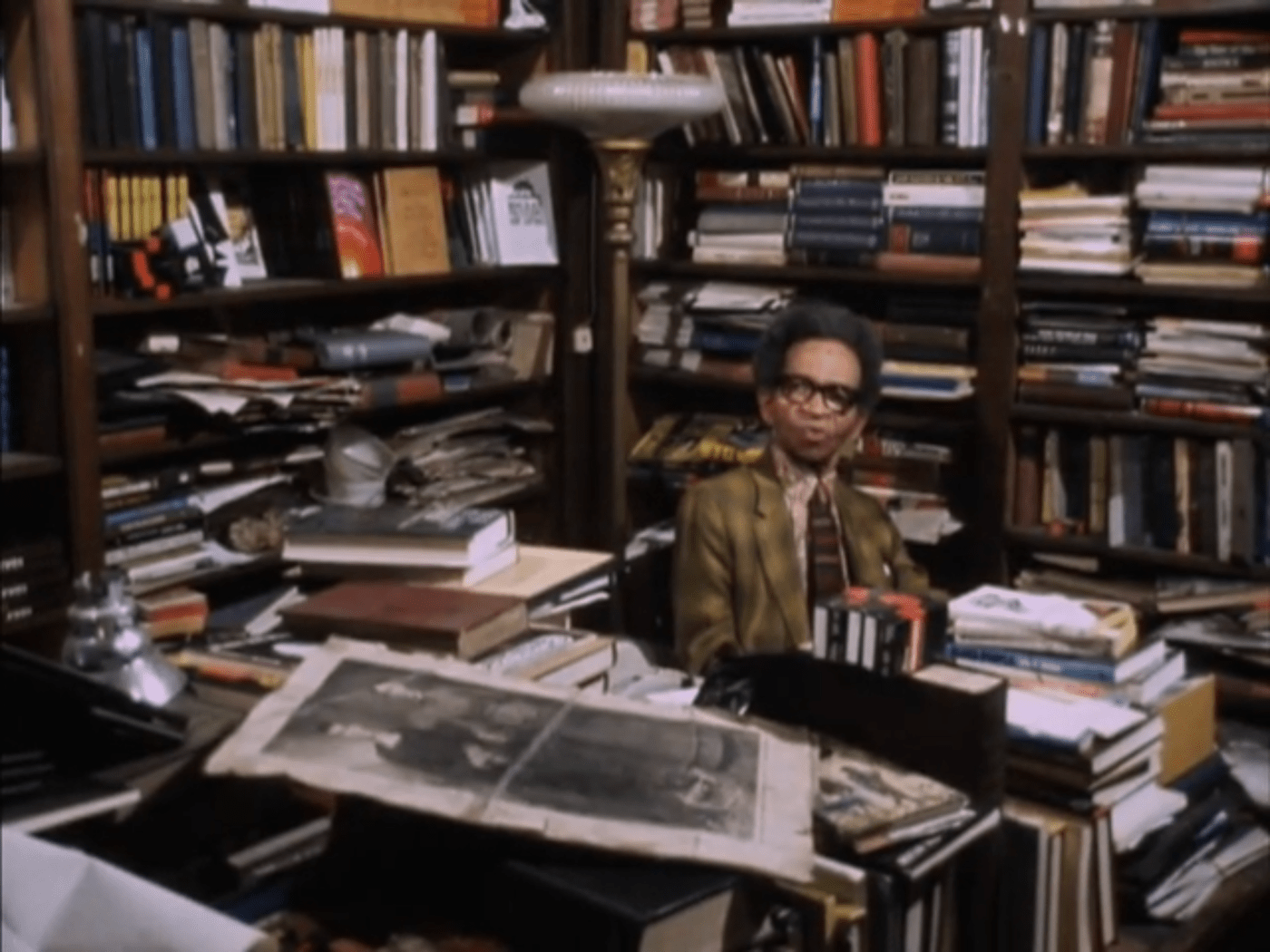
From starting with a pushcart in 1939, Michaux has a fully stocked bookstore by 1946. What is unique about his bookstore is if someone had no money they can read in a back room. The store became a hangout for Harlem intellectuals. Everyone from Langston Hughes to Nikki Giovanni had book signings there. Lewis would go out on his pushcart every day with his rhyming slogans to drum up business.

One of the people that enjoy his catchy slogans is a woman named Bettie Logan. She was around twenty years younger than Lewis, but they hit it off as soon as they started dating in 1952. In 1955, they married and had a child Lewis Michaux Jr.

Malcolm X met Lewis back in the 1940s when Malcolm was “Detroit Red.” Malcolm went to jail and emerged as a Nation of Islam minister. He was given charge of Muslim Mosque No 7 in Harlem. When Lewis saw him again in 1958, he could not believe his eyes.

The Nation of Islam was proposing a similar plan for Black America as Marcus Garvey. The way Malcolm presented it was more charismatic than his predecessor. Youth gravitated to him like no other black leader before. Malcolm was a permanent fixture in the National Memorial African Bookstore. When he broke from the nation of Islam Lewis gave him a donation to start Muslim Mosque Inc.

In 1968, the state of New York decided to buy the block that hosts the bookstore. Governor Rockefeller himself made sure the store stayed open by moving it a few blocks to 101 West 125th St. It became tough to keep the store going in a new location. To add to the trouble, doctors diagnosed Lewis with throat cancer in 1973. His wife runs the store in hopes that Lewis would recover soon. The state then decided to build another government building at the store’s new location. Lewis has no friends in the state house at this time, and the store closed in 1975. Lewis passed in 1976.

Sources
No Crystal Stair: A Documentary Novel by Vaunda Michaux Nelson 2004

Buy a copy HERE

Lewis Michaux Series

Lewis Michaux Biography

What Happened to Black Bookstores

Dr King in Four Quadrants

Michaux’s Real Estate and Government Aide

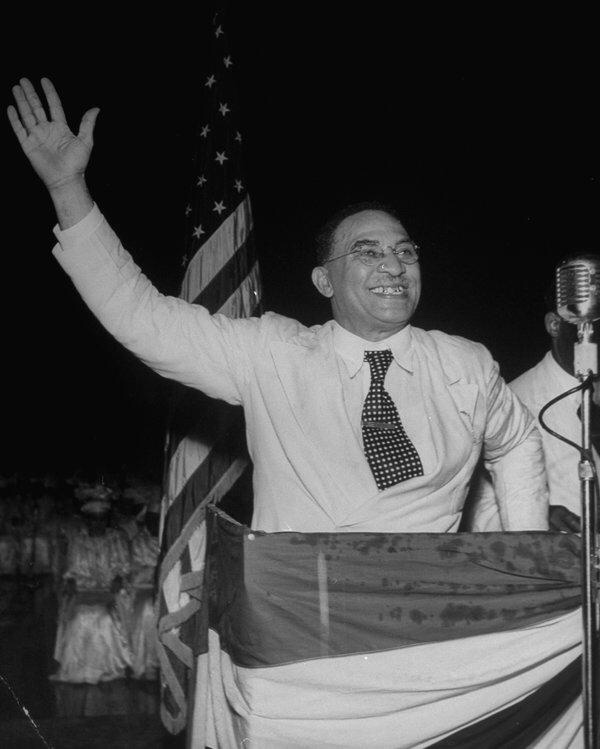
By 1933, Michaux had several churches in many states and a radio show. He was one of the most prominent black men in the USA. He cast himself as a modern day prophet. One night in 1933, Michaux had a prophetic dream. He saw a white eagle representing the church. There was a blue eagle, the New Deal reforms. Both teamed up to fight the Red Eagle of communism. Michaux talked about this dream on his radio broadcast.

One of the listeners was Hugh Johnson of the National Recovery Administration. He had been looking for black voter outreach. Michaux could be the perfect person to accomplish this task. At the time most blacks voted Republican. Johnson sent Michaux an invitation to join the Good Neighbor League.

Once America elected Roosevelt in 1932, Michaux became a Washington insider. He accompanied Major Richard Wright on a goodwill mission to Haiti with other prominent blacks. Wright owned a business that exported Haitian coffee. Most of the delegation was looking for business opportunities in Haiti. Michaux was there attempting to take his church international. Ultimately he felt Haiti was not a place to expand his congregation, but he and Major Wright struck a deal to sell coffee in Michaux’s “Happy Time Cafe.” Major Wright was instrumental in ending the US occupation of Haiti in 1934. The goodwill trip happened in 1938.

In 1934, The Gospel Spreading Church of God bought a farm that would become the National Memorial to the Progress of the Colored Race. Williamsburg was the place the first African slaves landed in 1619. Michaux had a plan to build a farmers co-op, memorial, and a church on this land. He began fundraising in 1937.

In the 1930’s Williamsburg was building their tourist attraction, a recreation of the colonial settlement. Town officials felt the Monument to Progress would be an eye-sore. So the town called into question Michaux’s methods of fundraising. There was also a move to claim eminent domain on Michaux property and force him to move to another area. The questions about Michaux’s ethics in fundraising caused the decline of his radio show and the cancellation of the national broadcast in 1939.

So Michaux had prominence and pull before working with the FBI in 1939. He did not become a propaganda agent out of desperation. It was a calculated move he made because he felt it was the right thing to do. The Bureau Clergyman, the organization Michaux became a part of pushed a conservative theology to support the status quo. Often Bureau Clergyman would disparage Civil Rights leaders. Michaux will be one of the first men to put forth the rumors that Dr. King was having affairs.

Michaux also needed to have as much influence as possible. He was having legal troubles building his monument to black progress in Williamsburg, VA. The town did not want a black statue creating a blemish on their colonial Williamsburg project. Michaux was also eyeing a sizeable real estate venture in DC called Mayfair Mansions. As the Mayfair Mansions project moves on, Michaux will become further and further in debt. The White House influence will be instrumental in keeping the project afloat.

It was also true that no one could turn down J. Edgar Hoover. We now know Hoover would often manipulate presidents. A storefront preacher would never stand a chance against the FBI. Many black leaders were labeled communist in the era. The red scare ruined the careers of many Leftists, black and white. If Hoover approached him, there was no way he could say no.

A black architect named Albert Cassell had an idea for middle-income housing development in Washington, DC. Cassell had pushed for investors for over a year before contacting Solomon Michaux. Michaux had insider connections with government and wealthy individual. Cassell paid Michaux $12,500 to use his influence to find investors. Michaux brought on: George Allen, DC City Councilman, Harry Butcher, wartime aide to Eisenhower then working for CBS, and Marvin McIntyre aide to FDR. Cassell and Michaux rounded out the original shareholders, all holding 20%. The property that was the Old Benning Road Race Track was purchased in 1940 was used as the construction site.

The district outlawed gambling in 1908. A bill was currently in the City Council to bring the practice back. Luckily, an honorary deacon of the Church of God was on the council, George Allen. Michaux decides to write a telegram to Allen, reminding him of his religious duties. Allen was also ordered to sell his racehorse at a discount to prove his piety. No one can know if the letter influenced his vote, but one can be sure the one-fifth share he had in Michaux’s Mayfair Mansions project tipped the scale. No one knew then Allen was a Mayfair shareholder. Allen votes NO, and the District of Columbia upheld gambling prohibition.

The Federal Housing Authority approved a $ 2.5 million loan, and construction began in 1942. In 1943, Michaux realized he needs more money to complete the project. To secure more funds, he needs to influence the Reconstruction Finance Corporation. There is only one person Michaux knows with enough pull to get the supplemental loan, Mary McLeod Bethune.

The appeal to Bethune was based on the fact that this was the only middle-class federal housing project subsidized by the government for Negros. If the plan failed, blacks would not get another chance for a generation. Bethune agreed and talk to Eleanor Roosevelt. In 1944, the Reconstruction Finance Corporation approved another $682,000. It didn’t hurt the George Allen was in charge of the Reconstruction Finance Corporation at the time.

Mayfair Mansions was not the only project Michaux was constructing in the early 1940s. The commemoration of the passage of the Thirteenth Amendment with the holiday Freedom Day was a passion him and his friend Major Wright. They worked together to influence FDR into ratifying the holiday. Unfortunately, FDR would never make the holiday law. Wright and Michaux began the first unofficial celebrations in 1942.

Michaux “predicted” Truman would win in 1948. God had given Truman stewardship of America for seven years, according to Michaux’s prophecy. Because of Michaux’s enthusiastic support, Truman invited him to participate in the victory parade. Michaux also presented Truman with a painting of Major Wright after he died to commemorate the great Civil Rights Leader. Truman made National Freedom Day law in 1948.

A Senate investigation of Michaux’s business dealings in Mayfair Mansions began in 1951. During the investigation, it was proven that Allen and Butcher owned stock in the project. Allen claimed to have donated his share to the Gospel Spreading Chruch before assuming the role of director of the RFC. Butcher also gave his shares to the church as a result of this investigation. The Senate Committee never finished the investigation. In addition to the Senate investigation, Michaux was delinquent on loan payments. The Treasury Department investigated why Michaux had not paid taxes from 1948 to 1951. Again the investigation abruptly ends with no penalty to Michaux. It is only logical that either Truman or Hoover intervened. Anyone else would have had their property foreclosed on and been sent to jail.

Albert Cassell falls on hard times and has to sell his shares to Michaux for a paltry $40,000 to save the Cassell family farm in Maryland. In 1954, Cassell sued Michaux and the Mayfair association for back pay as the architect of the Mayfair and the money invested in the project. The results of the case could not be found, but it is known that Cassell lived in the Mayfair until he died.

Once Truman’s seven-year stewardship ended. Eisenhower takes up the presidency. Eisenhower was a Republican. So Michaux support was held with suspicion. Michaux made Eisenhower and honorary deacon of The Church of God and wrote him many letters. Staff answered most of the letters. Michaux did receive one invitation to the White House after he led an all-night prayer vigil for the president’s health after a heart attack.

Michaux was able to obtain a new loan to buy the property just north of Mayfair Mansion. The new project was called Paradise Manor and financed with a $6 million loan from Redevelopment Land Agency. By 1960, the only influence Michaux had in government was J. Edgar Hoover. The track record of Mayfair would not have justified an even larger loan, so again it is only plausible to think Hoover pulled some strings. Michaux would not live to see this project completed because he died in 1968, Paradise Manor would not be complete for months after his death.

Upon Solomon Michaux death in October of 1968 many factions attempted to gain control of his fortune. There were three wills. The first will filed in 1958 stated that his siblings would get his fortune, and after their death, it would go to the church. The second and third will gave all the wealth to the siblings in perpetuity. The estate consisted of $25,000 in life insurance, $200,000 in properties mainly in Virginia, and $8 million in shares of the $15 million Mayfair and Paradise complex.

The first contestant was Lewis Michaux, Solomon’s younger brother. His position was that no one would give their property to the church when they had a family. He vowed to take what was rightfully the property of the Michaux klan. Lewis was not named in the first will, but his ex-wife, Ruth, was named. Solomon more than likely left him out because he left the church to go to New York. Lewis files his petition to be executor in April of 1969.

There were also many church factions. One of the church contestants was Marion Butler, a church official in Virginia. He contended that the Virginia churches get the land in their state and operate autonomously.

The second church contestants were Raymond Willis and Robert Hampton both officials in the Washington DC branch. They contended that Solomon Michaux used church funds to keep all his real estate projects afloat, so the real estate should go to the church. They had canceled checks from the church bank account to prove their case. Also, Solomon Michaux said in many church sermons that members should will their wealth to the church upon death. The Willis-Hampton faction wanted the nine churches to split and become independent.

The third was James Taylor, who believed he should be overseer of the church and that the church should stay united. To be overseer he had to be licensed to marry people in every state the Gospel Spreading Church operated. He lacked licensure in Washington, DC at the beginning of the church dispute. Taylor only wanted to keep the church united; he didn’t care what happened to the outside real estate holdings.

Taylor’s first attempt at DC marriage licensure failed. He claimed to be an assistant pastor at the Washington, DC branch of Michaux’s church. Pastor Willis sponsored him at first, but once he found out Taylor was trying to take the church over, he pulled his sponsorship. On Taylor’s second attempt he claimed he founded a new church in the same spot with the same people as the current Washington, DC branch.

The church faction dispute ended on May 17, 1969, when James Taylor won in a court case and received a license to perform marriage in Washington DC. The fact that Taylor alleged to start a new church was never brought up in the hearing. Therefore the judge awarded James Taylor a marriage license. Taylor becomes the overseer of the church and decides not to challenge Lewis Michaux. Taylor demoted Willis, who was the pastor of the Washington, DC branch to giving sermons on Saturday night.

Lewis Michaux was named an executor in September of 1969. However, the fight was not over. A fourth will emerges that was allegedly created three months before Solomon Michaux died. Rabbi Abraham Abraham was named executor. The Rabbi did participate in baptism and secured holy water from Isreal for church events. Atty James Cally authored the fourth will. Cally claimed to be unaware that Solomon Michaux died until 1970. Upon learning, he filed a petition in Washington, DC.

During the deposition, Rabbi Abraham Abraham did not recall meeting Atty Jame Cally or the other witnesses that signed the will. Cally claimed that Solomon was in good health when he entered his office. The family testified that Solomon was too sick to clothe and drive himself. None of Solomons servants remembered driving him to a law office in July of 1968. Neither James Cally or Rabbi Abraham Abraham showed for the hearing. The judge ruled in favor of Lewis Michaux. Fortunately, Lewis gave the Gospel Spreading Church control of the Mayfair and Paradise later that year.

In the end, Michaux’s life is a mixed bag. He preached against Dr. King hurting the Civil Rights Movement. On the other hand, he did provide the only federal subsidized middle-class housing in the nation. The idea of slavery as a positive good was the basis of his theology. On the other hand, he had a soup kitchen that fed hungry black people in the depression. Instead of seeing Michaux as a sell-out, it is better to see him as someone that prioritizes helping those closest to him over the greater national Civil Rights Movement. His skewed priorities is not a justification for the damage he did, but a warning for those of us living today not to let personal ambition get in the way of the more significant fight for liberation. A nuanced look at his life could offer more guidance than writing him off as a sell-out.

Website Powered by WordPress.com.

Up ↑